Summer Pot Watering

Summer Pot Watering

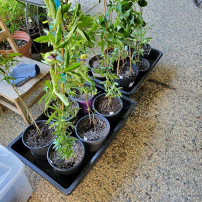
Several potted plants being watered in a black plastic tub.You know the rule about watering potted plants—water until the water runs through. I watered the plant that LaVille is holding just last night. Well, water did run through, but look at the dry section she is pointing out. I was surprised at how quickly the passion vines had been wilting. It is obvious the water was just channeling through without soaking the soil. We thought the rapid wilting was due to the pot being too small, so LaVille started repotting into 2 gallon pots. As soon as the first gallon pot was emptied, it was obvious what the problem was. She decided to go ahead and repot all 12 passion vines anyway. We then soaked the new pots into the tubs shown in the second photo.
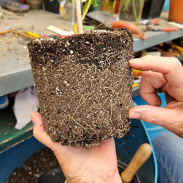
 

So, I guess the lesson for you is this: If you let a potted plant get really dry, watering so that the water passes through may not insure thorough soil dampening. You might try lifting the pot after watering so see if the weight indicates water retention. I suppose you could insert a moisture probe deeply into the pot to check moisture at different levels. And, of course, if you choose soaking the pot, don’t forget to remove it. A drip pan would be another solution.


Incidentally, we found over a dozen caterpillars on these plants. We transferred them over to the huge mother plant. We will soon have a yard full of gulf fritillary butterflies. You could experience that same joy.


Stan, The Soaker Man
Got Knitting Needles?

Got Knitting Needles?

It has been a long time since I sent out a blog. No one has complained, but I will ignore the possible inference.

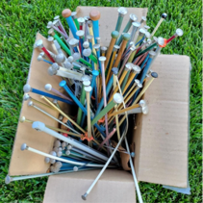
A cardboard box full of multi-colored, mismatched knitting needles

I just watched a video on TikTok (yes, I watch TikTok a lot). It showed another technique for testing the moisture content of a potted plant. Ya know how you stick a toothpick into a cake that you are baking to see if it is done. If stuff sticks to the tooth pick, you know it needs to go back to the oven. Now I have never done this myself, but LaVille seems to relish this procedure. Anyway, if you stick a knitting needle into a potted plant, where soil sticks to it upon removal tells you the depth of the moisture. I know I have touted the use of moisture meters, but I have found that the soil texture can vary the results. Besides, here is something new for you to experiment on. (Don’t you just hate it when a sentence ends in a preposition?)


As you can see, I have quite a collection of knitting needles. I bought this batch probably 30 years ago at a garage sale for a little bit of nothing. Other than using several pairs to teach the grandkids to knit, none of these has been used by us because we prefer circular needles. (You should see some of my scarves.) So, if the box appears dusty, it’s because it’s been in the attic all these years.

Stan, The Knitting Man

Soulful Sneakers

Soulful Sneakers

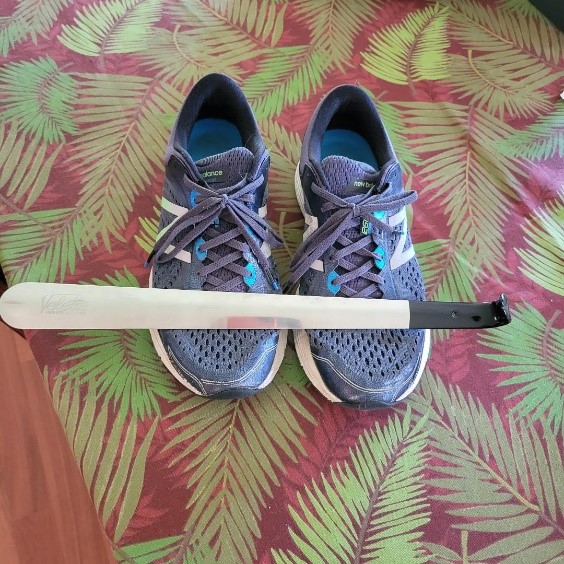
Long-handled shoehorn atop a pair of sneakers

Once again, I am sending you a blog not as a fellow gardener, but as a caring friend. You can see in the photo a shoehorn laying on top of sneakers. Now these are not just any sneakers—these shoes have a soul that can communicate with the wearer. In this case, these sneakers perceived the moans and groans as I bent over to tie these shoes. In a soft and gentle voice, they told me to tie the bows in a knot.

They said to remove the sneakers at the end of the day, simply use one shoe to press on the heal of the other. Then use your bare foot in a similar fashion to remove the other shoe. They said to immediately search on Amazon for long handled shoehorns. There I would find 2 shoehorns under the Velette brand for $15. Now, these wouldn’t arrive for 2 days, so I was told to plan on wearing a different pair of shoes until my order arrives. The shoes said to order a second shoehorn because they had heard moans and groans from the other side of the bedroom.

 I have been to a lot of estate sales, and it was not uncommon to find a long-handled shoehorn among the estate remains. It always made me somewhat sad that whoever had died, had to resort to using such a device. Well, guess who must be getting old?

 When that time arrives for you, you may find your soulful sneakers talking to you. If you bought them at Fleet Feet, they were expensive. That’s the price you pay for English speaking sneakers. If you bought them at an outlet store or a store like T.J. Maxx, you paid less, but the language spoken won’t be English. You will need to use Google Translator unless you happen to be lucky and can speak that same language.

 In the meantime, don’t fret. When that day arrives, simply listen to your sneakers and do what they say—life will be easier if you do.

Stan, The Old Man

Reach Hoe

Reach Hoe

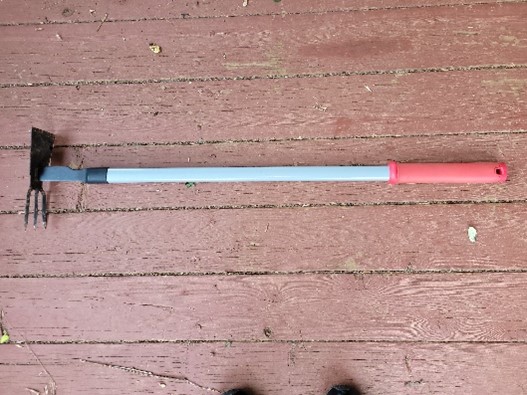
Tool 3 feet long designed for work in raised beds.

Here is a tool that Phyllis Wilburn suggested as a solution for my knee problems. I was complaining about the difficulty of crawling around the garden after Birdseye Pearlwort. She says this tool is her primary weapon combating Common Bittergrass.

The handle is 3 feet long. This tool is designed particularly for work in raised beds or in tight situations where a long handle would be cumbersome. The hoe blade is narrower than a regular hoe. This allows the user to apply more force to the soil. The cultivator side is a bonus. If you are interested, you can purchase the Corona Extended Reach Hoe and Cultivator on Amazon for 17 dollars.

Stan, The Hoe Man

Got Butterflies?

Got Butterflies?

Finally, an article that should have meaning to almost every reader. Everyone I know loves butterflies. Their flash of color and erratic flight cannot help but put a smile on your face and improve your spirits. Now, if you wish this to happen to your face and demeanor, I have the solution: buy one of the many passion vines that LaVille is propagating for the April Plant Sale.

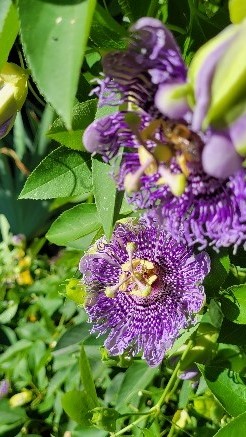
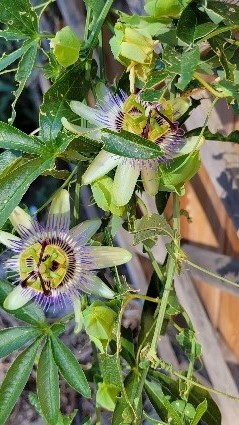
If you buy one at a nursery, you will probably be disappointed. LaVille has found that the Fritillary butterfly is very selective about the kind of passion vine upon which they wish to lay their eggs. They do not like the red or pink bloom varieties. They really love Passiflora edulis and P. caerulea. LaVille is growing both.  So, get one or two vines from her.

You are going to plant them now where they will get good sun exposure. Winter will stunt their growth and you will cut them back to two feet or less. Spring will produce lush growth and Fritillary butterflies will find them and lay their eggs. Then the eggs will hatch, and you will find caterpillars munching away on the leaves. I have to caution you that the butterflies really prefer the delicate leaves of the caerulea. We have to constantly transfer caterpillars from the caerulea to the edulis, otherwise all that will remain is bare stems.

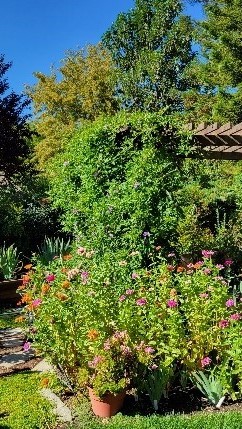
Next, to keep things rolling, you need to provide food for the butterflies. You probably have your favorite butterfly attracting plants. LaVille prefers zinnias as you can see in photo. Plant zinnia seeds in April to greet the butterflies as they emerge from their cocoons.

There you have it—a simple way to make your garden a source of wonderment and joy.

Stan, The Butterfly Man