Pruner Helper

Pruner Helper

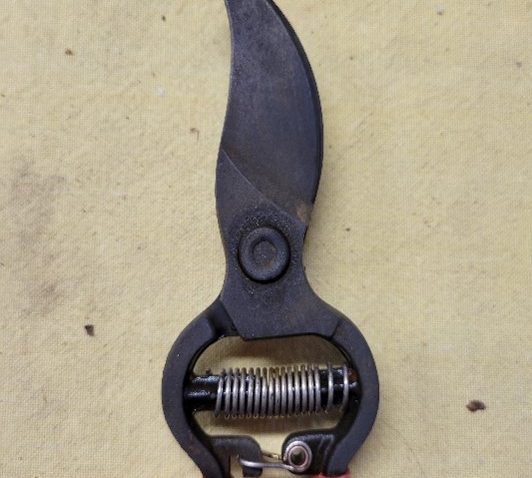
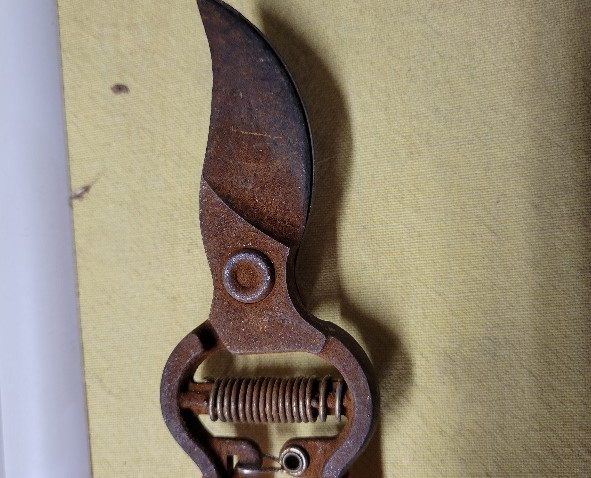
Do you have a pruner that no longer has the part that locks it closed? Well, I have a solution for you. I was sharpening tools at the Shepard this last weekend, when two pruners came in that were kept closed with a rubber band—not just an ordinary band—but the wide kind you occasionally find bundling fresh produce. Although I hardly ever throw anything away, my supply of veggie bands was limited to two. Neither were strong enough to close the pruner blades, but perhaps you will have a stash with the proper sized band. Perhaps you noticed in the photo that the pruner lock was still there. I simply didn’t have a pruner with a missing lock. How ‘bout the spot of rust on the blade? Shameful huh? I removed it immediately. Did you notice the dirty hand? Hey—I’m working with tools and getting ready for the next sharpening event at the Gardener’s Market. What, you may wonder, would I do with a rubber band when it’s not in use on the pruner? Just wrap it around 2 fingers.

Please let me know if you have some small sized bands that you don’t need that I could use for pruners that arrive for sharpening without locks. How about a section of bike inner tube—mine was too small. Anyway, I think it would be a pleasant surprise improvement for my tool sharpening clients.

Stan, The Tool Man

Rubber band keeps pruners closed

Rubber band keeps pruners closed

It’s Not Pretty, But…

It’s Not Pretty, But…

I was reminded by the sight of my muddy tennis shoes that I really need to tell you again of the value of having a power washer. I am fortunate to have the perfect set up with a power source and water source right together. Perhaps you are as lucky. So that I can reach every area of the back yard, I have added two 30 foot extensions to the spray wand. Rather than coiling this hose, note that I have looped it from side to side over the hose bib. This allows me to easily pull off the number of loops to reach the needed area. Coiling hoses is one of my least favorite chores. Note also the “patio cleaning attachment” that stands next to the machine. This an invaluable tool for cleaning slab, pavers, and sidewalk areas. Now, I am the first to admit that this permanent display at the back of the house is not pretty, but man is it always convenient.

So, how would you use a power washer? Well, other than cleaning muddy shoes and pavement areas, how ‘bout bird baths, flowerpots, plant trays, your car (be careful here), decks, rain barrels, shovels, totes for propagation, garden ceramics and statuary, pavers, and house windows? I use this power washer every week because the only thing we don’t have from this list is a deck. If you like to clean stuff, I really think you should have a power washer, and Sun Joe has a tremendous variety of products from which to choose. I think you would be very pleased with the SPX 3000 model.

Stan, The Cleaning Man
P.S. If you would like to try out a power washer before purchase, you are welcome to come over and play with mine–there is always something around here that needs cleaning.

Muddy shoes

Muddy shoes

Power Washer

Power Washer

Big Pot Problem

Big Pot Problem


Many of you have really large flowerpots.  If your pots are narrower at the opening, you have a problem when it comes to removing the plant.  If you want to save the plant, extracting it from its vessel can be difficult.  One solution it to break the pot—not the ideal option.  Now if you don’t care for the plant, the chore of removing it and the soil can still be difficult.  I have written you before about using a soil auger, and that will work.

Another option you might consider is planting your valued plant in an inexpensive plastic pot—one that is tapered for easy plant removal.  The plastic pot can be raised to the desired height with wood blocks, bricks, or rocks placed beneath it.  This also creates room for water run off if your large pot has no drainage holes. You can see in the photo I have drilled two holes in the rim of the plastic pot and inserted wire to make handles that will allow me to lift the pot out.

There are so many beautiful large planters out there at nurseries.  I can see how you would be tempted to buy one that narrows at the top.  Please consider using a second pot inside—call it pot insurance.

Stan, The Pot Man


If I Die

If I Die

I prepare plant labels for both the Sacramento Iris Society and the Sacramento Perennial Plant Club.  The labels for the Iris Club are cut to around 10 inches and are made of aluminum.    The labels for the Perennial Club are cut to 5 inches and are made of plastic.  We have found that plastic is easier to write on, and these labels always have a lot in information on them.

Now, I have shown below the two devices I use for label preparation.  You can see the metal stop that is taped to the guillotine table.  The length to which metal blinds are cut depends on the distance between the cord holes in the blinds.

After the blinds are cut to desired length, I tape a bunch together, and round the corners on an inverted belt sander.  The bunches of the same length are then washed in a bucket with a dish washing solution.  Then comes the fun part when I dry the labels while watching TV.  The last label drying event was Sunday while watching the Super Bowl.

So, you see, someday I may have to pass this duty to another person.  LaVille has refused.  I really like making labels, and I am hoping there is someone out there who will take over this enjoyable task in the future.

Stan, The Blind Man (mini, that is)

Cutting Board

Cutting Board used to right-size blinds into plant labels

Plant labels made from blinds

Plant labels made from blinds


Got Sheets?

Got Sheets?


With the advent of a freeze forecasted for the 22nd, I thought it timely to remind you to protect your tender plants. Although there are special sheet-like products available, old bed sheets will work fine. Got no old sheets? Then plan on going to estate sales.  They are a sure find. In the photos below I have placed old X-mas tree lights (estate sales again) beneath the sheets. These maintain a temperature above 50 degrees through the night to protect the abutilon seedlings that are growing for future sales.  If you plan on using plastic sheeting, don’t let the plastic touch the plants.

I just went outside to take a photo of the plants that the sheets were protecting. The abutilons have really grown well through the winter for the last 3½ months since cutting. We lift off the yellow tables each morning. A timer controls the lights, and that rug is a deterrent from tripping over the cords. The south exposure creates an extra 10 degrees of air temperature, and the pots most exposed to the sun are wrapped with white bubble wrap.

Stan, The Propagation Systems Manager Man