by Stan Logan | Jun 22, 2020 | Design
Last year I constructed a lattice-like structure for the garden. It consisted of 2 by 4 foot metal black grids supported by 4×4 posts. I chose to use 3 grids because I knew that a odd number of items is generally preferred. The structure stood for months and every time I looked at it, it didn’t look right. I finally figured it out. The grids were nearly invisible, but the 4 posts were quite noticeable. It bothered me so much that I extended the lattice with a fifth post and additional grid. Now I’m happy . . and felt I should expound a little on this concept of displaying an odd number of features. I asked LaVille why an odd number of items is preferred over an even number. She said that I was now dealing with art. I didn’t fully understand her continued explanation. Google to the rescue: “An odd number of details is more effective at capturing your gaze. Odd numbers force your eyes to move around the grouping. That force movement is the heart of visual interest. It’s for that reason that a set of three is more appealing and memorable than something paired off in two’s.” So, if you never considered the importance of displaying plants in odd numbers—particularly 3’s, give it a try. The same principle applies to home decoration, but I’m hardly one to give advice in that realm . . but I have been watching a lot of HGTV lately.
Stan
by Stan Logan | Jun 22, 2020 | Weeds
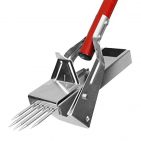
Here is tool you may find useful. If you have a significant weed population that consists of a lot of isolated large weeds, this may be your baby. The way this tool works is that you stab the tines into the soil in front of the weed. You may push the tool deeper with your foot if necessary.
Weed Popper
Then, by pressing the lever at the back of the tool, the tines will pivot upwards and lift the weed with its root out of the soil. The Weed Popper would not be useful if your weeds are growing among valued plants, nor would you use it to remove weeds in a lawn. But let’s say you have a large property that you have protected with a generous application of mulch. Isolated weeds eventually will appear and using this tool will keep you off your knees and perhaps be easier to use than a hoe. If you google “weed popper” you can watch a video showing its use.
Oh great! It’s at this point that I tell you where to buy and how much. Guess what? As of 6/22/20, this tool is unavailable.
All right—let me give you another option:
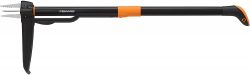
The Fiskars 4-Claw Weeder works in a different fashion. You stab the tool over the center of a weed and press it farther with your foot. When you pull back on the handle, the 4 claws close on the root of the weed and yank it out of the soil. I have had one of these weeders for well over a year and never used it. I got it free at a garage sale. I have no large weeds, so I went over to my next door neighbor and attacked the dandelions in his lawn. I found it was extremely effective. After the weed is extracted, you slide the orange handle down and the weed pops right off. The only problem is you must hit the center of the weed in order to grab the root. I have to admit that it was fun pulling out these weeds. It was difficult to stop, but when I saw a path of dandelion carcasses all over, I realized that I had a lot of evidence to clean up. The advantage this tool has over the one above is that the weed doesn’t have to be isolated.
If you also have fun weeding, I think this may be the ideal tool to increase your joys in the garden.
The Fiskars 4-Claw Weeder is available at Amazon Prime for $41.48 or at Walmart for a few dollars less.
Happy weeding!
Stan The Tool Man
by Stan Logan | Jun 3, 2020 | Weeds
It is hard enough keeping up with the invasion of weeds in your garden without having plants conspiring against you. I am currently trying to eradicate both spurge and moss from the garden. Since both of these terrorists are tiny and prone in development, they have found an ally in baby tears. 45 years ago we bought a 4 inch pot of baby tears. Do I need to tell you more? For decades it has been a challenge keeping baby tears confined. Now to confound my frustration, they have buddied up with not only the moss, 2 species of spurge, but even the Johnny Jump-Ups have joined the conspiracy. My response to these chums is “Burn baby, burn”! You would think that the word would get out and the baby tears would stop there conniving behavior. But, no—the battle ensues on a daily basis–and will until I run out of gas.
Oh, by the way, would you like a clump of baby tears?
Stan
by Stan Logan | Jun 3, 2020 | Garden tools
I thought that duplicity was a good thing—having duplicates of things you value should be a good thing. My wife straightened me out—as she is prone to do—that duplicity is not a desired trait. So . . you can call this practice of having multiple items whatever you want—I still prefer duplicity. Actually . . “multiplicity” is not a bad alternative. Anyway, let me tell you about the extent of my duplicity—I’ll stick to garden related items. The logic for my practice is many-fold: It is so frustrating when you want to use a particular tool, and you can’t find it. Having many around solves this. I have four 2 x 5 inch trowels used for the daily hunt for weeds. There are 3 or 4 moisture meters around here somewhere. I have only 2 of those thinning pruners that I have shown you, which is scary—only two. There are 2 sets of knee pads. I only have one weed torch, but I seem never to lose it, so one will do. What I am definitely going to have to buy is another pair of gloves. I am constantly misplacing the one pair—so maddening. Gloves are not something I think you can just buy online. I think you really need to try them on before purchase. 3 gardening hats, 2 neck braces. And 2 forearm bands round out my multiplicity needs. It should be mentioned that other than the problem of misplacement, there is also the consideration of wearing out a loved item and not being able to replace it. So I would suggest that when you find a gardening item, or anything else that you really love, immediately buy a second (or third) one. I have to admit that my fetish for multiplicity ends with my wife—I can only handle one of these at a time. Anyway, where would I find another one as good as I have right now?
Stan
by Stan Logan | May 20, 2020 | Container plants
I knew that title would get your interest. Now that I have you, let me tell you about something I learned about replanting potted plants. LaVille and I learned this while watching Gardener’s World on Prime Video. It seems so simple, that I am almost embarrassed not to have known of it before. When you are transplanting a potted plant either into a larger pot or into the ground, dig your hole, and then place the entire pot into the hole. Adjust for height and add soil around the pot. Firm it up. Lift the pot and its plant out of the soil. Pop the plant out of its pot and drop it into the perfectly formed hole. If the plant is so overgrown that it interferes with packing soil around it, first remove the plant from the pot, set it aside, and use the empty pot to form the new hole. For better growth results LaVille always adds Sure Start to the hole.
I hope you will remember this technique the next time you do your planting. It is really efficient and effective.
Stan
