by Stan Logan | May 20, 2020 | Container plants, Irrigation
Every now and then I get a good idea. I think the last time was June 14, 2005. This new idea cannot be claimed as my own, but then at least the plan to pass it on to you is my own.
I was watching an episode of Gardeners’ World on Amazon Prime when they had a segment about a lady who had a garden with 1,259 pots—and I don’t mean dinky ones. These were all different and some were quite large. Sounds crazy, huh? Apparently she inherited this pot fetish from her mother who had 700 pots. Now, this is not the significant part. What is—is that she watered all of these by hand using a watering can that she dipped into 21 different dipping containers that were spread throughout the garden. These 21 reservoirs are kept filled by a drip system. Now maybe you don’t mind dragging a hose around the garden, particularly if you have own of those expandable hoses that is light weight. But consider this: What if you had a large garbage can that was in a convenient place in the garden that you could fill once in a while and add a light dose of fertilizer. Now besides not having a hose to mess which each time you water, you are regularly giving your plants extra nutrients. Good idea?
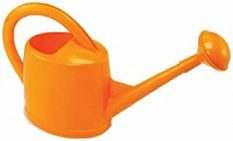
We have been using this system for a month now. I use a pump and long hose to fill two 55 gallon barrels—one on each side of the yard. The water comes from our koi pond so it already has fertilizer added. The plants absolutely love it. LaVille uses a watering can that has a handle that runs fore and aft, so she can water with one hand with the other one free to test the soil moisture of each pot. She only has one good arm left anyway.
She frequently loses track of the watering can, so I tried buying another. I finally found the right style on Amazon Prime. (Dramm 7 Liter Watering Can 12433, $38.22) There are many models that are far less expensive, but they all have bales that are mounted crosswise.
Watering Can
So even if you don’t have a pot fetish, you may want to try out this new idea. LaVille would never admit to a fetish, but with the added SPPC plants, she does have over 250 outside containers and 50 inside.
Stan, The Tool Man
by Stan Logan | May 20, 2020 | Garden tools
Here’s some advice if you have a leaking pneumatic tire:
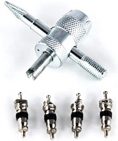
One of the four tires on my garden cart had a bad leak. Every time I wanted to use it, I had to add air. The next day it would be flat again. I assumed that the inner tube had a hole in it, so with significant difficulty, I removed the tube, added air, and submerged it in a bucket of water. To my surprise bubbles appeared not from a hole in the tube, but from the valve stem. I happened to have an extra valve, so replaced it. That solved the problem, but it would have been so much easier to test the valve stem before I went to all the trouble of removing the tube. So my advice to you is that if you have a leaking tire, fill the tire, and then place a drop of soapy water over the valve stem. If you are lucky, bubbles will appear and the fix will be easy. You can order a tool and replacement valves from Amazon Prime: Slime 20088 4–Way Valve Tool with 4 valve cores ($3.99)
Valve stems
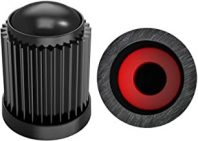
Now that I think of it, perhaps the reason that the valve went bad was that it had no valve cap. If that is the case also with you, you might consider ordering valve caps as well: Samikiva Black (30 pack) Tire Stem Valve Caps ($3.99) (Or you could call me—I have lots.)
I hope this solves your leaking problem.
Stan, The Tool Man
by Stan Logan | May 13, 2020 | Weeds
For some reason this year my garden has been under an intense attack of moss plants. I suppose the most likely cause is the drought we’ve experienced. Perhaps moss plants sense a coming doom and have sent out a flood of spores. Normally I blame unusual weed seed dispersal on my leaf blower, but moss plants are appearing where that cause is unlikely. What I’ve decided is the most likely hypothesis is the fact that moss plants are growing on the roof—particularly in the shade of our huge hackberry tree—and the spores are being spread throughout the garden by the wind.
I googled moss on roofs and learned that not only will moss plants tend to lift asphalt shingles, but also causes them to deteriorate. More research revealed solutions. There is a product called “Moss Out” that is designed to kill moss on roofs. I thought $20 for a bottle was a little much, but I bit the bullet. Before I applied a diluted solution, I spent two days scraping as much moss off the shingles that I could. The most effective tool for this task was my trusty 2 x 5 trowel that I keep urging you to buy. Then, using a hose, I washed the debris off the roof and collected the runoff in a rain barrel. This seemed to be far more logical than using my leaf blower. The moss plants are supposed to be first wet anyway. I then applied the solution.
I checked the roof several days later, and frankly, was not impressed with the results. Perhaps the moss was deader than it looks. It’s not as though it’s going to wilt or something. Not to be deterred, I moved on to the next idea: Apparently the metal zinc is toxic to moss plants. I have ordered a 50-foot roll of zinc metal sheeting. When it arrives, I will install it along the ridgeline so the when it rains, the dissolved zinc will flow over the moss plants and kill them. This is supposed to be a slow process and results may not appear for several months during the rainy season, but I am patient as well as persistent.
If you have experienced a similar attack of moss in your garden, you might simply need to look above you to find the source of the invasion.
Stan, The Moss Man
P.S. My wife insists on a disclaimer that I am not encouraging you to get up on your roof. You might instead hire a professional moss scraper instead.
by Stan Logan | Mar 19, 2020 | Garden tools
bucket handles
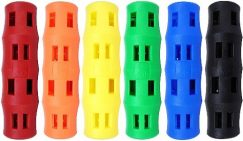
I hate to throw anything away. I go to extreme ends to fix something before I give up on it. For example, when the plastic handle surrounding the bail on a bucket starts to crack, I wrap layers of duct tape around it making last years longer. Recently I learned of a new device that solves this problem even better. Now available is a replacement handle that will snap around the bail when the old plastic handle gives way. The best feature is the fact that it is a larger handle that makes carrying thing even easier. If you google Amazon, you will see that “replacement bucket handles” come in a variety of colors for about $2 each. If you treasure your buckets as much as I do, I think you’ll give it a go.
Stan, The Tool Man
by Stan Logan | Mar 19, 2020 | Safe Gardening
Sooner or later you will injure yourself while working in the garden. This possibility is actually increased by the fact that if you are using a tool I have sharpened, it will be razor sharp. Your tender skin simply cannot resist the blade of a properly sharpened tool. If there is any consolation, you will be surprised at how painless the cut will be. You see, the sharper the cutting edge, the less nerve tissue damage there it. And it’s not just the tools that can hurt you. The garden is like a battle ground–with enemy thorns, rough bark, splinters, rock and concrete surfaces and just plain pokey branches just waiting for you to make just one careless move. You might win the war, but sooner to later you will lose a battle.
Now most of you will probably ignore the wound and continue your gardening chores. I, however, cannot. Any tiny skin puncture results a blood flow that simply won’t stop because of the blood thinner I take. So I have to go inside and apply a bandage. Here is where my advice comes in: Use Nexcare clear waterproof bandages. After washing the wound area thoroughly (do as I say, not as I do) and drying, apply antibacterial cream or ointment to the gauze pad, and stick on the bandage. Now you are literally covered for days. These bandages are unobtrusive and will remain stuck to you skin until you get around to finally removing it days later. And voila, the wound is completely healed. Now I realize that severe wounds are not treated just with a bandage, and although one of my sons swears by super glue to stick open wounds back together, you are going to have to use a certain amount of common sense in dealing with accidents in the garden. In any case, stock up your medicine cabinet with Nexcare clear waterproof bandages and a tube of antibacterial cream or ointment. You want to be prepared for that next accident that will occur.
Stan, The Tool(?) Man
