by Stan Logan | Feb 19, 2022 | Propagation
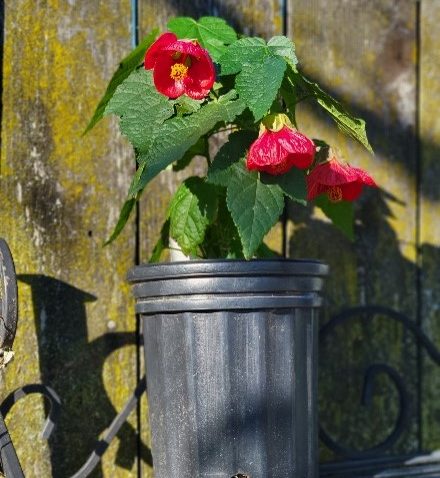
| Just look at thia photo. Can you not fall in love with a beauty like this? This abutilon is growing from a cutting obtained from a small tree growing in a friend’s back yard. This particular variety is a miniature that typically grows to about 18 inches, but in Sharon’s yard it has stretched up to four feet in search of more light. LaVille so loves abutilons that she is propagating 10 different varieties. These are practically the only outdoor plants that she is working with in preparation for club sales. Instead, she is growing many different indoor plants with an emphasis on begonias, hoyas, and peperonias since these plants are easy sellers.
Look for LaVille at the next Perennial Club sale. She is willing to share the love with you.
Stan, The Lover Man |
Abutilon |
by Stan Logan | Feb 18, 2022 | Container plants, Irrigation
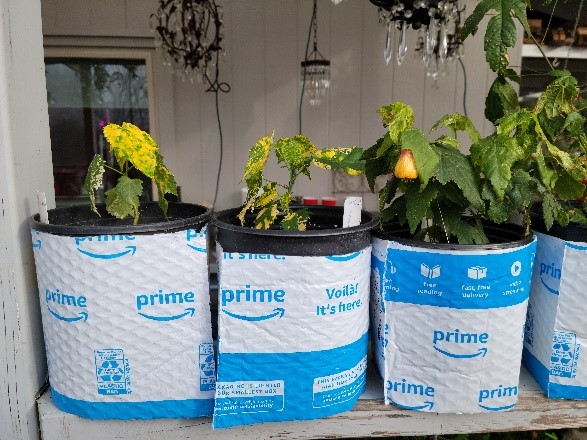
| Growing plants in those ubiquitous black gallon pots can pose a problem. Some plants prefer full sun exposure. However, intense sun rays are absorbed by the black plastic surface and converted into heat. When the planting soil within get hot, root damage results. One solution to this dilemma is to line the insides with bubble wrap. A much easier solution is to shield the outside. I have found the perfect heat barrier. Amazon sends a lot of its items in white bubble wrap pouches. The most common size they use fits around a gallon pot perfectly. If you cut the bottom off and cut the height in half to about 6 ½ inches, you will create tubes that will easily enclose two pots, keeping them cool, and yet allowing the full exposure of the sun to your happy plants. This technique creates a reusable shield that will postpone recycling and most certainly prevent deposit in the local landfill. If you are receiving Amazon Prime delivery pouches and have no use for them, we could certainly use them. LaVille, for instance, transferred 30 abutilons into gallon pots today. However, LaVille says I can’t order more stuff from Amazon just to get more bags.
Stan, The Reusing Man
P.S. I measured the temperature of the soil 1 inch from the edge of a shielded and an unshielded pot today at 3 PM. Shielded – 74 degrees Unshielded – 94 degrees. These are the results at the end of January. Imagine the results in August!
P.P.S. If the sight of all the advertising bothers you, turn the tubes inside out, but I’m not sure the shields will be as effective. I’ll test that out tomorrow and send you another email if there is significant difference. |
Bubble-wrapped pots |
| |
|
by Stan Logan | Feb 18, 2022 | Garden tools
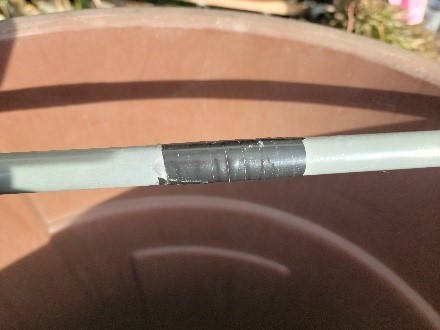
Figure 1 – Repaired Aluminum Wand |
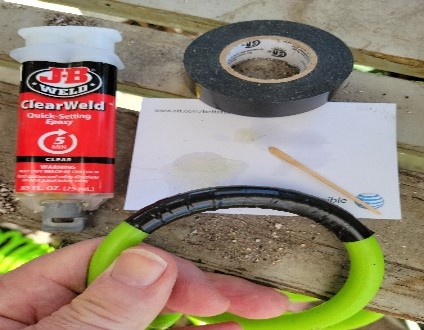 Figure 2 – Failed Leak Repair |
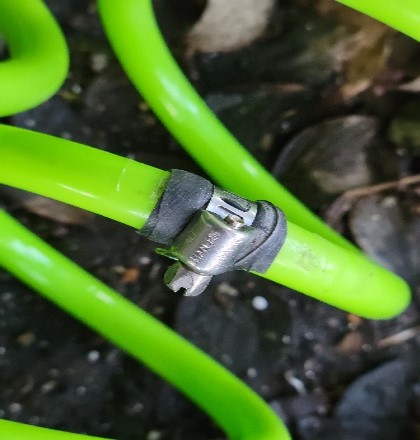 Figure 3 – Successful Leak Repair |
Have you ever had a problem that you were unable to solve? . . . Don’t you lie to me! Of course, that has happened. Although failure can be frustrating and disappointing, I think it’s a healthy option to simply accept the fact that you cannot succeed at everything you attempt. That scenario occurred recently when a leak appeared in the coiled hose that LaVille loves. (Not my sentiments, by the way.)
Since I had had success stopping the leak in an aluminum spray wand using epoxy (Fig. 1), I tried the same technique on her hose spreading an ample amount of epoxy over the area before taping. I was so sure it would work that I laid out the materials to be included in the photo (Fig. 2) for your information. I use JB Weld Epoxy so frequently that I just leave it out on my work bench.
Note in the photo that I mix the epoxy on a sticky pad with a toothpick and then simply tear off a sheet the next time I do a repair. Good idea, huh? Anyway, since both the electricians’ tape and epoxy were flexible, I thought the mend would work. Nope. Well, I thought a perfectly acceptable option would be to simply buy another hose, but when I attempted to uncouple the hose, it was really frozen at a union with mineral deposits. So, after that failure, I attacked the leak again with a tightly wrapped strip of bicycle inner tubing and a hose clamp (Fig. 3). The fix was a success this time, but only after failures.
I guess I’m sending a mixed message. I was willing to accept failure and go buy another hose, but the failure to be able to do that forced me to fight on until success was reached. In any case, I encourage you to think about using JB Weld for your repairs. and do your mixing on a sticky pad. But whatever problem you attempt to solve, be willing to accept failure as an option.
Stan, The Sometimes-Failing Man
by Stan Logan | Feb 17, 2022 | Garden tools
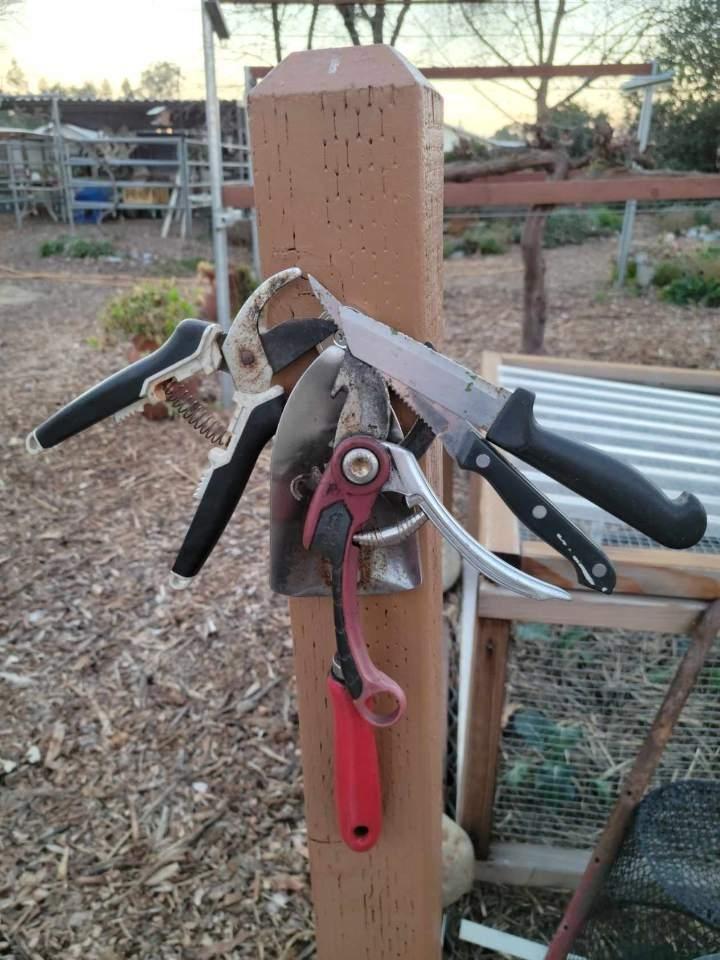
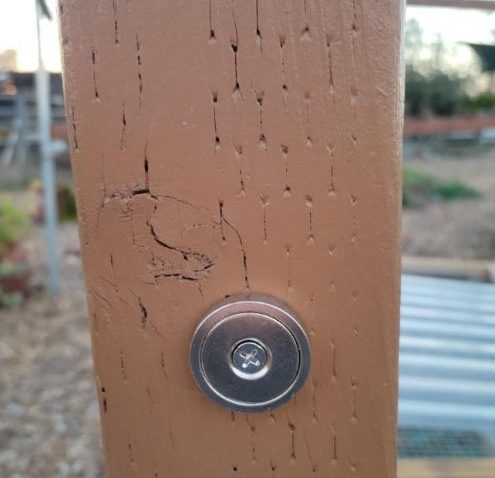
Yes, gardening friends, it’s time once again for another mystery tool contest. This tool comes courtesy again from Ruth Ostroff. (Do you remember her outstanding worm scraping tool?) This time you must guess the purpose of the round object attached to the painted post in the photo below. Once again, the person who emails me the correct guess first will be the winner. If no correct guess appears, I will reward the person who is most creative in her (or his) response. The winner will receive information as to how to buy this device.
The bonus challenge this month is to tell me the TV program that features a Mystery House in each episode.
And Beverly is disqualified for this contest since she clued us in to this series. Sorry Bev.
Ready. Set. Go!
Stan, The Mystery Man
Mystery Tool
GIVE UP? Click here to see this mystery tool in action.
by Stan Logan | Jan 26, 2022 | Container plants, Garden tools
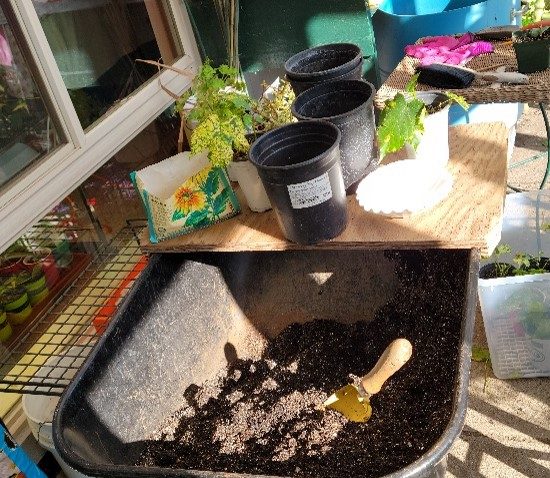
Here is an addition to your potting shed that is not new, but one that is new to us. LaVille was complaining about a sore back after working for long periods of time repotting plants. She was having to bend down into the blue half barrel that you can see in the upper part of the photo to scoop up potting mix. I turned our wheelbarrow, which is seldom used, into a potting station by cutting an old piece of plywood into a work surface and adding cleats to keep it in place atop the wheel barrow handles. Now LaVille can sit on a medium height stool and do her potting without bending over.
Wood tops wheelbarrow handles to form surface for potting plants.
The potting soil is a mixture of RediGro potting soil, perlite, vermiculite, and worm castings. Note the trowel that I have painted yellow (I hope you know why.) and the bag of Sure Start (which I have yet to discuss). The white coffee filters are to block the holes in the bottoms of the pots. The plants coming out of the quart white pots are variegated abutilons—my favorites.
I was surprised to find that we only have about 20 empty gallon pots remining. I never thought we would come close to using up the supply that I gleaned from the returned stack at Redwood Barn Nursery. I counted up the number of potted gallon pots around the yard and came up with 145.
If you would like your own portable propagation potting station, email me the greatest width of your wheelbarrow and I will cut you a work surface that will make this garden chore even more enjoyable.
Stan, The Tool Man
by Stan Logan | Jan 15, 2022 | Container plants, Garden tools, Irrigation
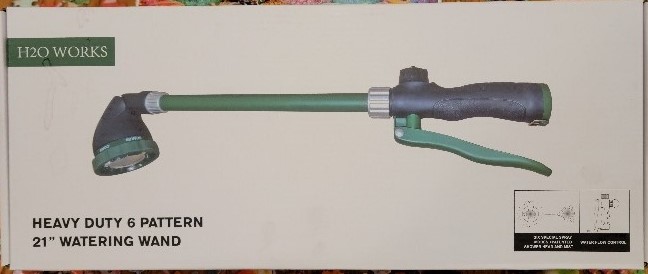
You know, it’s not easy coming up with a new tool to write about, but I am really excited about this one. As soon as I saw LaVille use it, I just knew there must be at least two other gardeners out there who would appreciate this one. If you are like my wife, she uses a watering wand almost daily. You see, she has probably around 100 potted plants that are under cover outside that don’t get the benefit of rain showers. So even in the winter, a watering wand is used regularly. The last wand was good—until it wasn’t. A crack appeared in the side of the aluminum shaft that caused LaVille to get sprayed along with the plants. I found that applying J-B Weld epoxy to the area, and wrapping with electrician’s tape sealed the leak. LaVille was still unhappy because . . . well, the wand was too long, the control valve was sticking, and the spray was irregular.
So I went to Amazon and ordered what you see below. This, in her opinion, is the perfect watering wand. Adjustable sprays, adjustable head direction, full and fine spray, and a short handle which can still reach higher up hanging plants and water a potted plant held in the other hand. (The full spray is emitted from around 200 minute holes!)
If you cannot read the description from the photo, I am talking about “H2O heavy duty 21 inch Watering Wand” from Amazon.
Happy watering,
Stan, The Tool Man
by Stan Logan | Nov 23, 2021 | Container plants, Irrigation
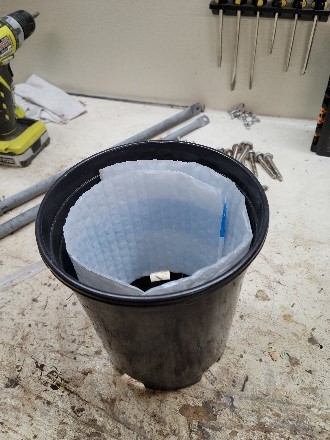
Cindy Eastman has her own method of dealing with hot pots. She lines the inside of her gallon pots with bubble wrap. If you are like me (sorry), you have a number of bubble wrap delivery pouches laying around waiting to be stuffed into the recycle bin of your local store. Consider re-using the plastic by cutting the bags into strips that can be wound around the inside of your black plastic pots. If you would like to show your gardening friends how clever you are, cut the strips a little wider so that they show above the soil level. I’m sure their curiosity will lead to fascinating conversation.
Stan, The Re-user Man
Bubble wrap lining a garden pot
P.S. The pot pictured looks quite tapered, but it is just the angle of the camera. I appreciate those of you who have been responding to my blogs. It often gives me ideas for future articles.
by Stan Logan | Nov 12, 2021 | Container plants, Irrigation
I suspect that many of you are growing plants in black plastic pots. The reason, or course, is that they are free. Whether they are small 4 inch square pots or 3 gallon round ones, there is always a free source for these containers. My main source is the Redwood Barn nursery in Davis. Customers constantly return used pots to the nursery for re-use. My concern is that you remember that these black pots are easily heated by the sun, and root damage can result. Even though the sun’s rays are less intense in the Winter, the rays are coming in at a lower angle and strike the sides of your pots more directly. The air is cooler now, but the sun can still release a great deal of heat into the soil of your potted plants.
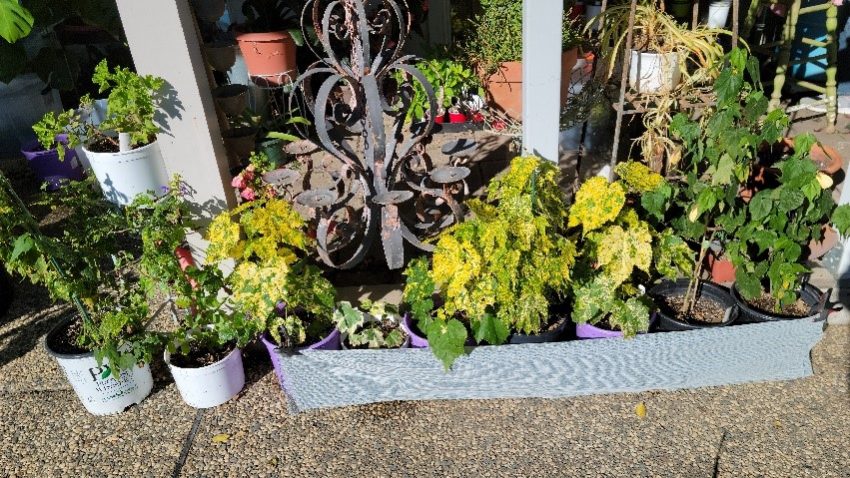
If you are growing plants that prefer full sun, you can still use various techniques to shade the pots. I’ve shown one of these below where I have clamped shade cloth in front of the black pots. Hopefully you have a more esthetic technique in practice. Notice that the white pots on the end have no sun shield because they naturally reflect the sunlight and don’t convert it into heat. So, if you wish to avoid the whole problem, use white pots. I noticed that Amazon has a great selection from 3 inch to 7 gallons. White pots show plants better anyway, don’t you think?
By the way, LaVille plants most of her “mother” plants for propagation in white pots—pots that will not go to sales by accident.
Stan, The Cool Man
White pots and shielded pots
by Stan Logan | Nov 10, 2021 | Garden tools
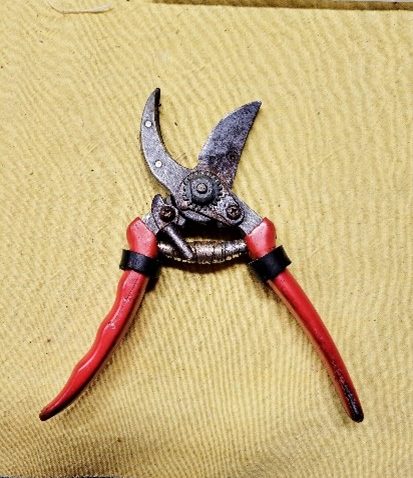
Before Plasti Dip Clippers |
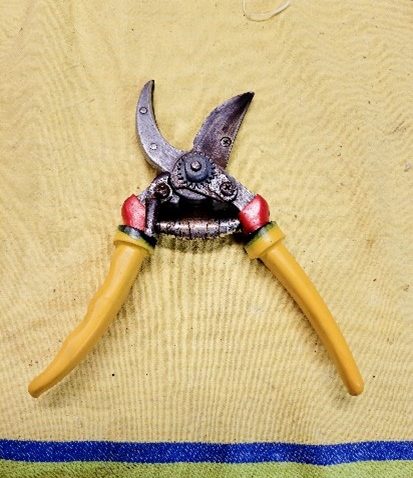 Clipper handles after Plasti Dip |
LaVille kept complaining about her favorite pruner. Her hand kept slipping down the handles toward the blades where she has less mechanical advantage. My first solution was to slide a couple pieces of rubber hose over the handles to act as slippage stoppers. Well, that worked fairly well except she started developing a callus where her hand met the black hose piece. My latest attempt to alleviate her agony was to buy a can of Plasti Dip. This is available on Amazon in a good variety of colors. I chose yellow as it is my go-to color for finding misplaced tools. You dip the tool handle into the tall, slender can and hang the tool to allow it to drip off excess and dry for 4 hours. What you see in the second photo is the result of 3 dippings.
You know, if you accomplish nothing else, you could use this technique to identify your own tools. Don’t you think it would be classy for all your tools to have the same color handles?
Quiz of the month. You will note that I ended up with a tool with red, black, and yellow handles. Name 3 major countries that have these 3 colors in their national flags. The first reader to respond by email with the correct answers gets . . . . nothing but my admiration. I know—Wow!
Stan, The Helpful Husband
P.S. You may have noticed in the first photo that the grips had worn through to the metal. You may consider this technique as a nifty means of tool upkeep. If nothing else, I would suggest you try Plasti Dip as simply a very different and easy project.
by Stan Logan | Oct 25, 2021 | Garden art
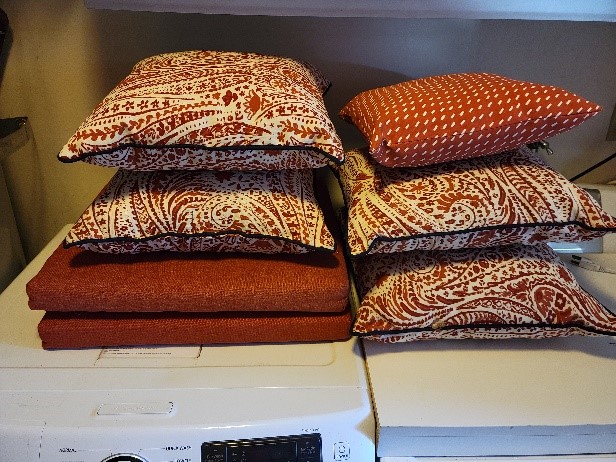
Outdoor pillows
The timing is right for me to pass on a cleaning shore I just discovered. The cushions you see below were on a bench in the back yard. When I pulled the bench under cover before the recent storm, I found the cushions to be covered with a sticky substance. The bench is located under our huge hackberry tree, and although I applied a systemic, the wooly aphids attacked again. Power washing did a decent job of cleaning the cushions but left them soaked. Hanging them on a clothesline left them soppy at the bottom. Then I thought of the clothes washer thinking that the spin cycle would remove most of the water. Since the cushions were small, I was able to fit several at a time into the washer. I used very little detergent and the cushions came out sparkling and practically dry. A fan finished the chore.
So, if you have outdoor cushions, now may be a good time to wash them before storing them away for the winter particularly if they got wet in the recent storm. If your cushions are large, I would still suggest you try squishing them into your washer. But better consider the cushion content first. I wouldn’t use this technique of washing unless the stuffing is a foam rubber pad. A front loader machine might also work better than a top loader since there is no agitator to mangle the cushions.
Stan, The Washer Man