by Stan Logan | Apr 7, 2021 | Garden tools, Irrigation
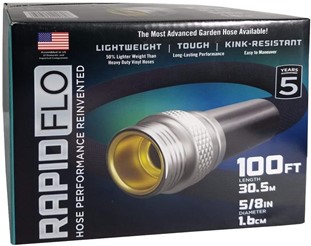
I’ve taken a chance here. While walking the isle at Costco, I spotted a pallet of boxes of garden hoses—RAPIDFLO 100 ft length, 5/8 inch diameter, lightweight, tough, kink-resistant. You see, LaVille has been wrestling with a rubber hose that has become stiffer with age. (What’s new?) She has had to drag it through the main iris garden and then wind it back up on the hose reel when done. So I uncoiled the old, stiff hose off the reel. Actually it now remains permanently coiled along the side yard. I then attached this new hose to the spool and turned on the pressure. I could see that LaVille at the far side of the yard was now watering with less than expected flow. Not only did the 100 foot length impede the flow, but the 5/8 inch hose itself was perhaps still somewhat flattened. Maybe continued use will expand it—probably not. Perhaps the company should change it’s name to SLOFLO. But LaVille says that the gentle spray was actually desirable. Anyway, when LaVille was finished watering, I had her close the spray wand valve to keep the hose turgid, and wound the hose up on the reel. You don’t want a flattened hose on the reel. That would really limit flow. The winding task was truly easy to do because the hose is really lightweight.
So, do I recommend this hose? The jury is still out at our house. I would say that if you are tired woman handling (Is that sexist?) an old, heavy hose around, this may be the hose for you. You can easily coil the hose in a large pot if you don’t have a reel. I am going to assume that this hose design is less likely to leak as the expandable hoses tend to do. Keep in mind that this is 100 feet of hose. It seemed a little long for my yard that is only 80 feet wide. As of 3/20/21, this hose if available at Costco for $39.99. If you miss it there, Amazon has it for $55 (Yikes!).
Happly hosing,
Stan, The Tool Man
RapidFlo Hose
by Stan Logan | Apr 7, 2021 | Garden tools
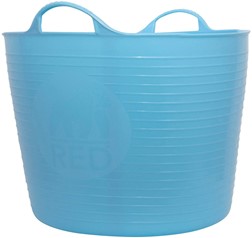
If you want to stand out from the typical gardener who uses the ubiquitous ugly 5 gallon plastic bucket to contain everything from tools to weeds, here is your chance. Tubtrugs is the maker of an entire line of colorful, flexible, containers that would fulfill your every need. I have a friend that bought the 10 gallon size, and liked it so well that he bought 3 more. Keep in mind that if you are like me and require the rigid edges of a bucket to assist your rise from the ground to a vertical position, this may not be your best bet. But for those of you with younger legs, here is your chance to secure the envy of all your neighbors and gardening friends. Amazon has a great assortment for you to peruse. And remember, if it rains, Tubtrugs has you covered—better go with the 10 gallon size.
Stan, The Bucket Man
10-gallon Tub Trug flexible plastic bucket
by Stan Logan | Mar 17, 2021 | Garden tools
Although not really a tool, plastic coated steel garden stakes certainly can qualify as a helpful item for successful gardening. The reason I am mentioning it now, is that I have recently been made aware of a deal that I would like to pass on to you. Most gardeners have a stash of stakes of various lengths. In fact many of the estate sales I’ve attended will have stakes if there was any history of gardening at the property—that along with a collection of fertilizers, chemical treatments and most importantly—gardening tools. But who currently wants to go an estate sale where you are often crowded in a house with strangers? I haven’t been to a garage sale for a year—sob, sob. Anyway, if you find your supply of garden stakes lacking, here is a source that will satisfy your needs for good quality garden stakes at a reasonable price. You can order these on line from Home Depot with free home delivery. Note that you can order lengths from 4 feet to 7 feet.
Happy staking!
Stan, The Tool(?) Man
by Stan Logan | Mar 16, 2021 | Propagation
Years ago I bought a pack of 60 sheets of yellow sticky traps figuring that it was enough to last a life time. I now see that the stack of sheets is running low. I’m afraid that does not bode well for my future. But until we both expire, I’ll keep plodding along.
The reason for my original purchase was to do battle with the white flies that like to infest our iris beds. Being cheap, I always cut the letter size sheets vertically into thirds and then hung these narrow strips throughout the beds every year. That technique has worked fairly well as whenever we walk through the beds, we purposely knock against the plants, the white flies fly up and zip over to the yellow strips to which they become stuck.
When LaVille mentioned that several of the plants she was propagating started to get white fly, I cut sheets into thirds and then those strips in half. I then mounted them on miniblind stakes and taped the stakes to the sides of the totes in which the plants were being raised. Well this was only partially successful as the stakes stuck to the totes, but the mini pieces of sticky sheet sometimes did not want to adhere to the stakes. The yellow sticky sheet material is flat and likes to stay that way—they didn’t want to bend around the bent stakes. Adding blue masking tape worked somewhat, but I found small metal clips worked as a last resort.
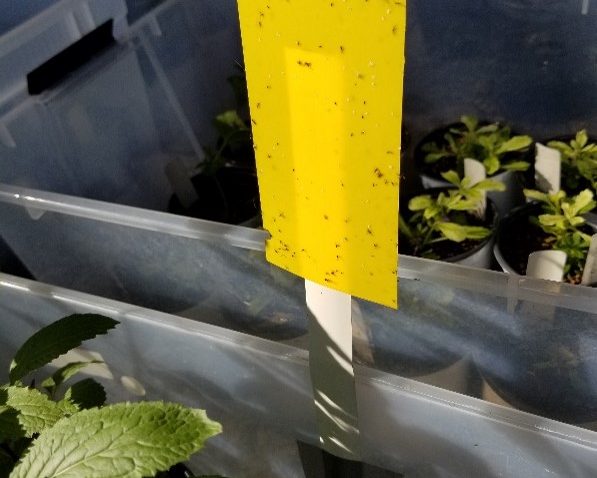
So far, pretty boring, right? Well, look at the accompanying photo. See the attached white flies? . . . No, you can’t. They are tiny, and blend right in with the yellow mini sheet. I just took a flashlight (It’s night time) and tried to count the white flies. I figure there is at least 100 on both sides of the yellow mini sheet. Look at the photo. Guess what those dark specks are? Those are fungus gnats. It’s a 2fer! After the sticky mini strips were in place for about 4 days, no flies or gnats appeared when we brushed the plants. Adults were eliminated, so the life cycle was broken.
So if you have any trouble with white flies or fungus gnats, try using these yellow sticky traps. I have to tell you though, working with these is a real pain. I mean these traps are really sticky. You can remove sticky stuff from you fingers with paint thinner.
Well, I feel foolish. I just checked Amazon and found that there are all kinds of small yellow sticky traps now available. Not only that—they actually advertise use on fungus gnats and flying aphids as well as white flies. Do I feel out of touch!
Stan, The Feeling Old Man
Capture gnats with sticky trap
by Stan Logan | Mar 3, 2021 | Garden tools, Weeds
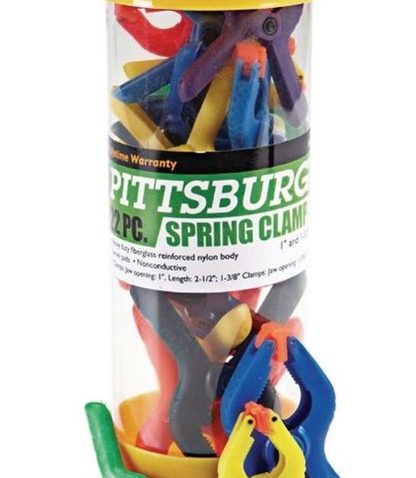
Once again it is beneficial to look outside the box. Here we have a versatile item that you won’t find in your local nursery. Please note that although labeled “Spring” clamps, these devices may be used during all 4 seasons—and especially in the Summer. You can see by the accompanying photo, that they are brightly colored, which will hopefully prevent their loss. (I haven’t seen your garden, but I suspect you may have the tendency to leave stuff all over.) This complete variety of color allows you to accessorize your gardening attire with clamps that will attach anywhere. I don’t have much capability, but I suppose you could even adorn your hair with these snazzy items. I tried this idea, but found it rather painful.
So how would you use these clamps in the garden? You could support plants. You wouldn’t pinch the plant itself—that would be cruel—but enclose the branch and clamp to a supportive structure. Using this on vines, tomato plants, and bougainvillea immediately comes to mind, but, really, any plant that requires staking would be a good candidate. Then there’s the need to attach sheet material—bird netting, shade cloth, frost protection, tarps. Could you use it to attach labels? How about hanging yellow sticky sheets. Maybe you need to close a bag of fertilizer. How ‘bout sticking one on your body to remind you to turn off the water.
I think you can see that there is almost no end to the uses for this versatile tool. You are probably not trying to decide whether or not to buy, but how many to buy. Well, the good news is that these clamps are really cheap. You can purchase a set of 22 clips for only $4.99 at your closest Harbor Freight, so don’t hold back!
Happy Clamping,
Stan, The Tool Man
P.S. If you really want to travel outside the box, google “clampers.” My brother-in-law is one of these.
Spring Clamps
