by Stan Logan | Jan 20, 2021 | Weeds
What are your thoughts when you hack at a weed with a hoe? How about when you plunge a weeder into the soil and penetrate the tape root of a plant you don’t appreciate. Have you ever paused when you were about to grab a plant by the neck and yank it out of the soil it depends on for life? When you use a propane torch to cook and then scorch a solitary weed and hear the popping of the seeds that would otherwise provide future generations of that plant, how are you feeling? Have you ever stopped to think that these plants that you so fervently pursue and torture with Roundup are simply trying to survive—to survive and continue the lifeline of their existence?
I ask you, “Where’s the empathy?” . . . Not here . . . But sometimes . . . . . . .
by Stan Logan | Jan 19, 2021 | Weeds
Generally it is a pleasant experience being on a gardening team. I know Daisy would back me up on this concept. But there are times when disagreements can arise—specifically, what plants need to be eradicated, and which are left to survive—what’s a weed and what’s not. You have heard the saying that it is easier to ask for forgiveness than to ask for permission. I have found that this axiom doesn’t work well when weeding in the garden. You see, once a plant is extracted, survival upon replacement is seldom successful. I have found that saying “You should have been watching what I was doing!” does not go over well. Or “It looked like a weed to me” doesn’t fare well either. I have found that frequent asking of permission has proven to the least painful option when weeding. I’m just sayin’.
Stan
by Stan Logan | Jan 18, 2021 | Garage and estate sales, Garden tools
I don’t know if you remember, but several times I have emphasized the importance buying tools that are as light as possible—as long as it doesn’t affect the quality or effectiveness of the tool. This would apply particularly to shovels and brooms. This fact was brought to mind when I recently received a birthday gift from one of my sons. This shovel arrived in a box from Lowes that was so mangled and mashed, that you wouldn’t think anything inside could have survived, but survived it did. Now, this 48 inch Cobalt steel digging shovel is really substantial—no wonder it survived. The handle is steel and the step flange is wide which is advertised to not hurt your foot (like I’m going to be out digging barefoot or in flipflops—come on!). Anyway, the point is that this shovel is heavy. Every time I heft the shovel, I am lifting the weight of the shovel as well as its load—wasted energy. This shovel is so substantial that it comes with a lifetime warrantee. If I didn’t know this son better, I would suspect that he has sights on this tool in the end, if you know what I mean. In the meantime, the shovel is awaiting a significant sharpening as the shovel blade is really thick.
Boy! When I digress, I don’t go halfway. I am trying the make the point that several tools are better when they are light. This is particularly true with leaf rakes, which you use by constantly swinging them back and forth. I am in love (not really) with a rake I found at a garage sale. It is the Blue Hawk 24 inch leaf rake. The Blue Hawk series of products are entry level tools from Lowes. The handle is made of light wood. The rake head is light plastic, and only the tines are metal. I found by accident that you can actually improve this rake. One day I was too lazy to pick up the rake from the lawn and thought I could pass over it without harm. The mower ripped off 4 of the tines on one side. (I never did find the tines.) I used this lopsided rake for many months until I came up with the idea of removing 4 tines from the other side by sawing through the plastic head. Now, through serendipity (stupidity) I have a long handled, narrow headed rake with long tines that is able to remove leaves from tight confines. Since then, I was able to buy another Blue Hawk at another garage sale, so I have a full-size rake as well. So, my suggestion to you is that, if you need a rake, go to Lowes and pick up one of these light-weight beauties for about $10. Then, if you want to improve your raking capability, buy a second one and cut off tines from each side. You can skip the mower part.
Happy raking! Stan The Tool Man
by Stan Logan | Jan 17, 2021 | House plants
Today I asked Rhonda to clean the house floors while I worked out in the garden. When I returned inside, I could not find her anywhere. What I did discover was several pots of plants that were knocked over. The leaves of the swiss cheese plants had been beat up so that the isolated leaf holes now extended to the mauled leaf margins. Rather miffed, I found Rhonda hiding under our bed entrapped in electrical wires. So I extracted her, dusted her off, and took her to her corner so she could recharge her system and hopefully be a more trustworthy worker in the future. Oh . . did I forget to tell you Rhonda is our Rhumba?
Stan
by Stan Logan | Nov 28, 2020 | Garden tools, Trees
Perhaps a dozen years ago, LaVille and I planted 12 different fruit trees. We followed the advice of the Dave Wilson Nursery and planted them in 3 groups of 4. There were 4 cherries, 4 nectarines, and a group of 3 pluots with a plum. Each group was growing on the same root stock. The planting pattern was a square with trees 2 feet apart. The goal is to have 4 stunted trees with a varied ripening sequence. Trees were pruned to keep the center of the group open and the height limited to a comfortable harvesting level. Sounds promising, right?
The nectarine trees never produced decent fruit. It may have been related to the fact that I was never able to control the peach leaf curl. So after probably 5 years, I removed them. This wasn’t too difficult, because the root systems weren’t huge.
The cherry trees were doing just fine. Sure, the jays took their toll, but we did have days of human grazing. Then the spotted wing drosophila arrived. The treatment was to apply a spray every 5 days beginning as soon as the fruit showed a blush of color. A couple years of futile effort lead to tree extermination. This was not easy as the biggest trunk was probably 8 inches across. My tools this time were a hand saw, shovel, and hatchet. I won the battle, but there were times when the desired outcome was in doubt.
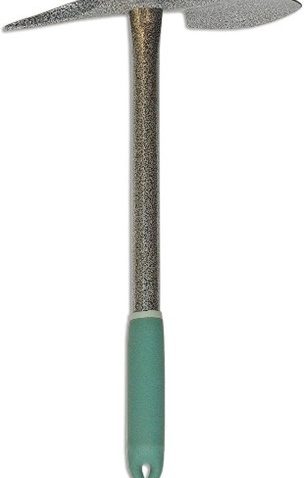
The 3 pluots and plum trees produced mixed results. The Montgomery plum was just OK. 2 of the pluots produced very little fruit. The Dapple Dandy produced an abundant crop each year. The fruit was large and had a marvelously tasty, sweet flavor. Then disaster struck. Remember that the center of the group is pruned to keep it open, so all of the fruit is produced on the outside of the grouping. Well, even after extensive fruit thinning, the Dapple Dandy had so much fruit on one side, that the trunk cracked open. That was also the straw that broke the camel’s back. All 4 trees were sentenced to termination. Being now an experience henchman, I added 2 tools to my arsenal. Most importantly was the reciprocating saw. It easily chopped off branches and shortened the trunk. It was indispensable for cutting through the roots which were large and intertwined with the roots of the other trees. Not only that, but unlike the cherry trees, these trees had a tap root which required me to excavate extensively to gain access to them. I found that a planting pick was useful for clearing soil away from roots to expose them for the saw blade. It is unavoidable to keep the saw blade away from the soil. I fortunately had bought a package of 5 9” blades, because the soil really dulled them fast. You can tell a blade needs replacing when it not only doesn’t cut, but the friction of the dull blade starts producing smoke. Even with these tools the task was difficult. I could only manage one tree per day.
In the end I did, of course, prevail. Now there is room for planting more irises, which is a good thing as LaVille has probably 30 or 40 growing in gallon pots.
Now, concerning tools, I have discussed both the transplanting shovel which I used and the reciprocating saw in previous articles. The saw is a must if you have serious tree work to do. I would recommend the little light weight planting pick if your soil is light. I have also found it useful for digging shallow trenches to bury drip lines. Most similar models are heavier and have a squared off chopping blade. The Planting Trenching Digging Garden Hand Tool from Amazon pictured below is like the one I used.
So . . . what does all of this have to do with hating trees? “Hate” is perhaps too strong a term for my attitude toward trees, but you can perhaps understand why I have a somewhat negative attitude. No one enjoys failure—least of all me.
Stan, The Tool Man
