by Stan Logan | May 27, 2021 | Container plants, Garden tools, Irrigation
With all the pandemic caused emphasis on home improvement, this would have been a good article to write a year ago. Better late than never. As usual, wanting to advise others comes as a result of mistakes I have made, some of which are described below.
Size: Length can be whatever you want. Width, however, should be no more than 4 feet. I have 3 beds that are 5 feet by 8 feet and it is difficult to do any work near the center of the beds. The one 4 footer is so much easier. The walls of my beds are made with three 2 x 6’s, so they are about 18 inches high. Now that I think of it, 24 inches would have been much better in terms of having to bend over less. But then, I think proportions look better at 18”—you gotta look good even if it’s painful. The higher you raise the box, the stronger the support needed to keep boards from bowing out if they are long. People use raised beds to make tending them easier and to create an enclosure for the new improved soil that can be brought in that, hopefully, plants will love. Most people find that a bed 10 or 12 inches high works well for them—not so much for growing tomatoes which are best planted 18 inches down.
Materials: Most people use wood. Redwood is probably the best. When you are picking out your 2-by boards, try to find those that have the most heartwood. The reddish heartwood is far more resistant to rot than the pale sapwood. Cedar is another good choice. Pressure treated wood is more controversial. No arsenic has been used in this wood since 2003-4. Currently 2 different copper compounds are used and although no traces of these chemicals have been found in either soil or vegetables, pressure treated wood is not recommended for planter boxes in which food is grown. You can alleviate you fears by lining the box with heavy plastic—say 6 mil. You can also seal the box with paint or another kind of sealer. One caution—avoid breathing the dust when cutting pressurized wood. Wear a mask. I know you know how to do that. More expensive, but far more durable is construction with masonry. There are all kinds of attractive alternatives here. The drawback is that you have to lean over farther to work with your plants and the material is not gentle on elbows and knees
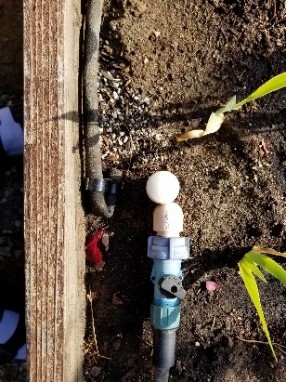
Misc. Plan ahead and bring irrigation lines up into the box. Cover the bottom with hardware cloth—you know, the substantial ¼” wire mesh, to keep varmints out. A layer of weed cloth will also discourage the invasion of roots from a nearby tree. Trust me—tree roots will love the great soil and water you have provided. If you are using wood, consider installing flat boards on the top edges for ease of sitting. Don’t just use screws to hold lumber together. Use lag screws, or better yet, use bolts with washers. If using lag screws, predrill to prevent splitting. You can attach a band of copper mesh around the outside to keep snails and slugs out—but not earwigs. Finally, as you can see below, if you use treated posts, you have to add preservative, sealer, or a cap to cuts that have exposed untreated interior areas.
In-box irrigation |
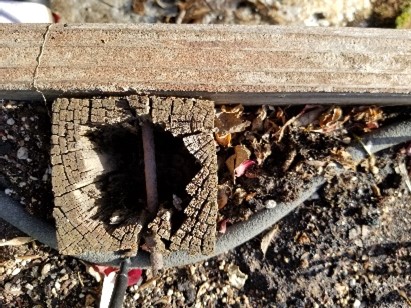 Rotting post |
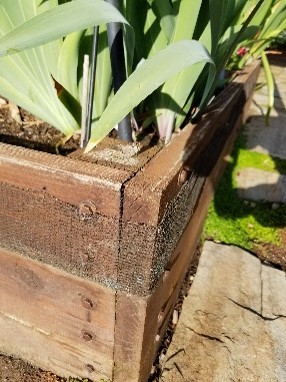 Copper mesh |
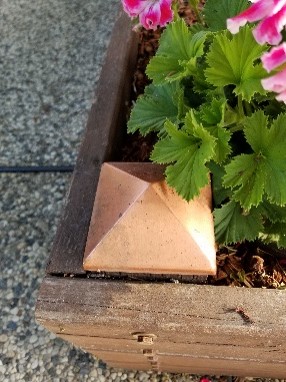 Post cap |
Why does most of my learning have to come at the expense of mistakes I have made?
Stan, The Blog Man
by Stan Logan | May 24, 2021 | Irrigation
I was recently notified about writing a blog concerning a very serious matter. You see, this person (who will remain nameless) accidentally left a hose running all night resulting in the flooding of her back yard. She was rather upset about this and felt that she, as well as others, need some suggestions to prevent this happening again. Here are some ideas:
- Electronic and mechanical timers that attach to hose bibs. The mechanical ones may not work if the volume is low.
- Electronic timers. These small battery operated timers are otherwise used as kitchen timers.
- Alexa is always willing to set an alarm for you.
- Exercise tracking watches sometimes have an alarm feature.
- Battery operated flood detectors will issue an alarm if water reaches the sensor.
- Rubber wrist bands that you store on the hose bib can be worn as a reminder.
- The most easily used device is your phone which I know is tethered to your body.
Hopefully you will find one or more of these suggestions useful so you won’t make the same mistake that Beverly (oops) made. Coincidentally I am using a wrist band right now.
Stan, The Blog Man
by Stan Logan | May 21, 2021 | Garden tools, Irrigation
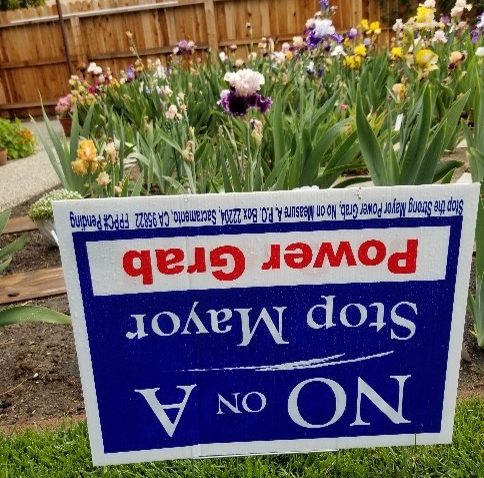
I recently had a newly cultivated area that I wanted to let dry out until planting. I used 2 political signs to ward off the spray from 2 sprinklers and they really worked well. By cutting off all but 6 inches from the supporting wire of the sign, you can poke it into the ground and move the shield wherever you want. The sign is made of corrugated plastic so it is impervious to water. On the other hand, you might want to shield certain plants from harsh sun rays. When not in use, these flat shields store efficiently.
As you know these signs are readily available when political issue are made public. You can either wait until issues are settled, or simply pick up the signs when they don’t agree with your viewpoint. ( My editor says I can’t say that.)
Stan, The Blog Man
Repurposed political signs as garden shields
by Stan Logan | May 17, 2021 | Safe Gardening
Here, unfortunately, is an example of “Do as I say, and not as I have done”. Moderation is a goal to which most of us aspire—whether it is diet, sun exposure, exercise routines, or mountain climbing. Gardening should especially fall into this category. For instance, I was barking in the front yard today. (“Barking” is the technical term for applying bark to your landscape.) It was 90 degrees out. It wasn’t too long before I was tired. So rather than pushing it, I went into the house and relaxed on my recliner. And, of course, fell asleep. I was proud of myself because I quit before I became exhausted, which has been the usual outcome of my gardening activities. (For your information the way you determine whether you are just tired, or truly exhausted is by the length of your tongue hanging out of your mouth.) This pause was just the first of many that occurred through the day. The motivation to overdo activities is to finish the job, and it is a very difficult goal to resist. But I implore you to consider your physical well being over your mental wellbeing (be it as it may). Give your body a break and take a break. The weeds will be willing to wait until you return. Besides, they will be easier to find. The mess of leaves will remain—perhaps not in the same location—but they will be somewhere. Water those potted plants and put them into the ground tomorrow. I think you get the idea. Be sensible in your gardening activities—save some of the fun until tomorrow . . or next week.
Stan, The Rested Man
by Stan Logan | Apr 28, 2021 | Soil
Have you ever paused for a moment when removing the debris from around a plant? That collection of organic matter that covered the ground not only helped to retain soil moisture, but eventually would decompose and release nutrients back into the soil. So as long as the debris didn’t harbor disease, the plant would be happier if you left things be. But would you be happier? Probably not, unless you dress up the surroundings with mulch. Even then I have seen examples of mulch covered gardens that I consider downright ugly. 3 to 4 inches of ugly doesn’t do a thing for me. On the other hand, I love the effect created by a covering of mini bark. I used to be able to buy “Pathway Bark” from Garden Time at Lowes, but now all they have available is “Pathway Groundcover” which more closely resembles sawdust than bark. If you were at Jeannie’s pop-up sale, you might have noticed how great the landscaping appeared as it was dolled up with a covering of mini bark. I asked her husband and he said he was able to get at Hasties. He said it was rather expensive though.
As usual, I have strayed from my original topic—that of the dilemma of whether or not you should clean up around plants in your garden—are you making the plants happier, or making you happier? You can do both, but more often I simply opt for me. Just being selfish, I guess.
Stan, The Blog Man
by Stan Logan | Apr 26, 2021 | Garden tours, Weeds
LaVille and I have recently joined the weeding group working to maintain the WPA Rock Garden. We meet between 9:00 and 9:30 each Thursday and park above the Rock Garden on the road that leads to the entrance to the zoo. A finer group of volunteers you’ll never meet. The task I have chosen is to attack the weeds in the paths with a torch. Now the torch I use is the same one I use almost daily in our garden going after newly germinating moss, baby tears, and annual bluegrass. Most of the weeds I toast are less than ½ inch high, so the small torch I use produces a small, concentrated flame that adequately bakes my prey. (It’s the same torch I described in the blogs on the SPPC web site.) Like I discussed before, the problem is that I have to bend over the weeds, and unless there is a breeze, the smoke rises up into my face. I bob and weave about trying to avoid the smoke, but the days following a burning session are sometimes accompanied by irritated eyes. I tried to solve this one day at the Rock Garden by wearing googles but was discouraged by the ridicule of my wife and the fear in the eyes of children walking the paths.
I just have to stop here and tell you what a fantastic place the Rock Garden is—thanks primarily to Daisy Mah who has made the garden so special. The winding paths bordered by walls of granite boulders encompass plantings that are marvelous. It is a joy to see adults with their kids wind through the garden. Professional looking photographers seem always to be there. Families have gatherings to celebrate occasions. It is simply a happy place.
Now, back to burning weeds: Not only was the smoke in the eyes a problem, but I was pretty much exhausted after bending over for a couple hours. And, of course, I always stunk of burned weeds afterwards. My solution was to borrow a long torch from a club member. I found this really worked well as the larger flame burned weeds probably ten times faster. But also used gas ten times faster, and in 2 days I went through 2 tanks of propane gas. I wasn’t too concerned because I was used to picking up tanks and garage sales and estate sales for no more than a couple bucks. I went to the Davis Ace—no tanks. I went to Home Depot—no tanks. I went to Lowes—no tanks. That’s when I found out that backpackers grab up these tanks as soon as they come in. OK—Amazon—yes, but they’re over $11 each and would take a week to get here from the East Coast (No combustible gas aboard airlines.) So I ordered a packet of 4—but just for use with my small torch in my own garden.
My new plan is to order my own bigger torch with a 10 foot hose that will connect to one of my 20 pound propane tanks used with the barbeque. I’m going to lash it to a hand truck and roll it around the Rock Garden and hopefully eliminate all the weeds in the paths in a couple sessions. I’ll add the results to this article after next Thursday’s session.
Weeks Later – I have to tell you that I am somewhat frustrated. I can’t find any more weeds to burn in the paths for the Rock Garden, and it’s tiring dragging the hand truck with the propane tank attached through all the paths because there are raised steps involved. But the good news is that I really love my new torch. I no longer have to bend over with my small hand-held torch. Smoke no longer rises up into my face. The flame is much bigger and really hot. If I can find the same model again on Amazon, I’ll picture it below. It has a self-starter attached so I don’t have to carry around a flint starter. Until you squeeze the handle, the torch stays lit with a gentle flame. Then when you press the handle a roaring flame shoot out. The size of that flame is easily controlled by the knob right near your hand. The 12 foot hose allows you to cover a big area without moving the tank. Using a 20 pound tank is much much cheaper than using the small tanks that attach directly to the torch. Plus you can always get the big tank refilled. Good luck finding a small tank to buy when you need it.
The bad news is . . the chance that a reader of this article would ever need this torch is slim. I can’t even use this torch on my own property. Our lot is average-sized for homes built in the ‘70s and there is very little ground left where there’s no valued plant growing. Then too, bark covers what is left. I’ll probably take the torch out front and cook all the weeds growing the joints of the sidewalk and in the cracks of the poorly maintained asphalt of the street. But other than that, my little torch is a far better choice for my personal weed problems. But if you are fortunate enough to have a large property and unfortunate enough to have a huge weed problem, this is one honey of a tool for you.
Happy burning!
Stan, The Tool Man
P.S. My editor says I should mention that this is a tool only for use by responsible users who are careful enough not to burn down the State of California.
by Stan Logan | Apr 22, 2021 | Garden tools
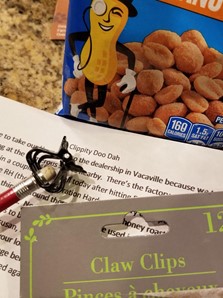
LaVille and I like to take our Hyundai into the dealership in Vacaville because we take two cars and we spend the hours shopping at the numerous stores nearby. There’s the factory stores, Target, Lowes, and many, many more all within a couple miles. Well today after hitting Eddy Bauer, Lowes (several geraniums and great bougainvillea), the RH (the new Restoration Hardware—very disappointing), and Target, we came across a Dollar Tree. The one thing we found there (other than the honey roasted peanuts and the Hot Tamales) was a package of Claw Clips. Normally these would be used in your hair (not my hair), but we have found these tiny spring-loaded clips to be really useful in the garden for supporting delicate vines—like peas, clematis, passion vine, black-eyed susan, hardenbergia, honeysuckle, and morning glory. So if you are into vines like we are, I suggest you visit your local Dollar Tree and seek out a package of Claw Clips—12 for a dollar. If you find a photo of a clip below, I was able to figure out how to transfer a photo from my phone to a document. If no photo, I failed again.
Stan, The Rambling Man
P.S. Don’t forget the peanuts! |
Dollar Store Claw Clips |
by Stan Logan | Apr 21, 2021 | Soil
You probably have noticed that you tend to lose soil through the drain holes in plant pots. Ages ago—I think it was the Pleistocene—we use rocks to block those drain holes. Then later I remember that we used chards of broken clay pots to prevent soil loss. Recently we have used that fiberglass tape that is used to cover the seams of sheetrock. I have 3 or 4 rolls of this tape that I’ve picked up at garage sales. What’s good about this product is that you can use it over and over again. I would give you a life-time supply if you would just let me know. But since I know you won’t bother to ask, here is another solution to your soil loss problem—coffee filters. The large size filters fit perfectly in the bottom of gallon pots and you can use filters torn in half or in quarter for smaller pots. Large pots are where we have to resort to the webbed tape (and remember I have lots!).
Stan, The Rambling Man
by Stan Logan | Apr 16, 2021 | Irrigation
OK hosers! This may be the hose you’ve been dreaming about. The Flexilla is a 5/8 inch, heavy duty, lightweight hose that is kink proof under pressure. I’m sure if you gabbed it firmly and gave it a good twist and pull, you could probably prove me wrong. You wouldn’t do that would you? Two of my closest gardening friends have this hose and swear by it. I ordered a 25 foot length and can join their chorus. Light weight and doesn’t kink—it’s a miracle. Perhaps its most valuable feature is that being really flexible, it lays flat which means you are less likely to trip over it. Its bright green color also helps too. It’s lead free drinking water safe to boot.
You can buy this hose in different lengths on Amazon, or find it in various local stores. If you look on Amazon you will see that it has had over 30,000 reviews! It’s a good time to be a hoser!
Happy hosing,
Stan, The Tool Man
by Stan Logan | Apr 11, 2021 | Garden tools
I would hazard to guess that you have either a can of WD-40 or a can of silicone spray, or both, in your arsenal of improvement products. Which of these is better? Let me give you my opinion. (If you don’t want it, stop reading.)
The term “WD-40” is derived from the fact that the aerospace company developing this product was trying to find a chemical that would displace water—thus “WD” stands for water displacement. As it happens, WD-40 was the 40th formula that was finally successful in keeping water away from the skin of the Atlas rocket and preventing corrosion. I have always found this fact fascinating. (Not so much for you?…Oh well.)
I always include a can of WD-40 in my supply of tool sharpening equipment. Not only do I use it to coat metal to retard rusting, but the spray tends to dissolve the gunk that accumulates on pruners and loppers. (Oven cleaner and a brush really does a thorough job though.) And, of course, it is a lubricant that reduces friction and stops those irritating squeaks. I also just learned from my Flipboard app (A great app for learning the latest news.) that WD-40, being oily, can be applied to wooden handles to reduce the occurrence of splinters. Then, too, if you notice that the rocket in your back yard is starting to corrode, this product is a must.
Now, silicone, on the other hand, is not petroleum based. Therefore it dries and has far less odor for use indoors. Since it dries, it won’t trap dust and dirt. Silicon is therefore ideal for lubricating the tracks of sliding doors and screens, lubricating tracks of drawers, improving the function of padlocks and doorknobs, and stopping the squeaks of door hinges.
On a personal note, I used WD-40 to lubricate the switch on my leaf blower. The blower was set aside on a flat surface and was still plugged to a power cord. While I was doing something else, the blower turned itself on, and since the air intake was blocked, the motor overheated and started a fire. Being a slow learner, I bought the same model of leaf blower again. Since the power switch on this one was sticking like the last one, lubricated again with WD-40. Believe it or not, this resulted in a melted switch. Who’da thought! I had to take the blower apart and hard wire it. Now I have to discnnect the extension cord whenever I want to stop blowing. So apparently it is unwise to use WD-40 on electrical switches.
So in conclusion, I would suggest that you have both of these products. Use WD-40 where you want to leave an oily surface, and use silicone where you want to lubricate but leave a dry surface.
Stan, The Slow Learning Man
