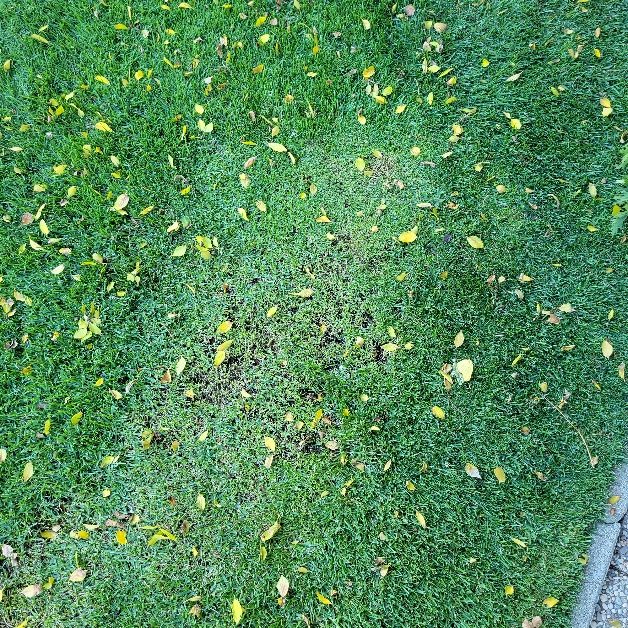
Lawn Holes

Lawn Holes

Oh! You have no lawn. Well, good on you. (Bad on me?) Simply skip this blog and continue scrolling. Now if you have a lawn, there is a chance that there are holes, or let’s say low spots. If you are one of those perfectionist weirdos who cares about a perfect lawn, please read on.

First of all, you need to scalp the grass in the low area. Set your mower for a low setting. Then use a leaf rake to raise up all the grass blades. Scalp again. Sprinkle some kind of filler material into the low spot. Most people use sand. I applied used potting soil.

We kill potted plants on a regular basis. If the plant is relatively new, I just put the soil back into the potting soil barrel. If the plant has been in the pot for a long time, I put the soil into a tub that stores that soil until a need in the garden arises. Sprinkle your filler material over the scalped area.

Use an inverted steel rake and rub it over the surface to level the surface and work the filler into the grass. Now water the area with a sprayer that forces the filler down into the grass. I use a power washer, and that works really well.

There you have it. What was surprising when I did this, and I used two applications about a month apart, the treated area actually looked healthier than the rest of the lawn. The used potting soil apparently still had unused fertilizer mixed in it.

A green lawn with yellow leaves.

Stan, The Perfectionist Weirdo

A Neatnik’s Dilemma

Have you ever paused for a moment when removing the debris from around a plant?  That collection of organic matter that covered the ground not only helped to retain soil moisture, but eventually would decompose and release nutrients back into the soil.  So as long as the debris didn’t harbor disease, the plant would be happier if you left things be.  But would you be happier?  Probably not, unless you dress up the surroundings with mulch.  Even then I have seen examples of mulch covered gardens that I consider downright ugly.  3 to 4 inches of ugly doesn’t do a thing for me.  On the other hand, I love the effect created by a covering of mini bark.  I used to be able to buy “Pathway Bark” from Garden Time at Lowes, but now all they have available is “Pathway Groundcover” which more closely resembles sawdust than bark.  If you were at Jeannie’s pop-up sale, you might have noticed how great the landscaping appeared as it was dolled up with a covering of mini bark.  I asked her husband and he said he was able to get at Hasties.  He said it was rather expensive though.

As usual, I have strayed from my original topic—that of the dilemma of whether or not you should clean up around plants in your garden—are you making the plants happier, or making you happier?  You can do both, but more often I simply opt for me.  Just being selfish, I guess.

Stan, The Blog Man

Losing Soil

You probably have noticed that you tend to lose soil through the drain holes in plant pots.  Ages ago—I think it was the Pleistocene—we use rocks to block those drain holes.  Then later I remember that we used chards of broken clay pots to prevent soil loss.  Recently we have used that fiberglass tape that is used to cover the seams of sheetrock.  I have 3 or 4 rolls of this tape that I’ve picked up at garage sales.  What’s good about this product is that you can use it over and over again.  I would give you a life-time supply if you would just let me know.  But since I know you won’t bother to ask, here is another solution to your soil loss problem—coffee filters.  The large size filters fit perfectly in the bottom of gallon pots and you can use filters torn in half or in quarter for smaller pots.  Large pots are where we have to resort to the webbed tape (and remember I have lots!).

Stan, The Rambling Man