Reach Hoe

Reach Hoe

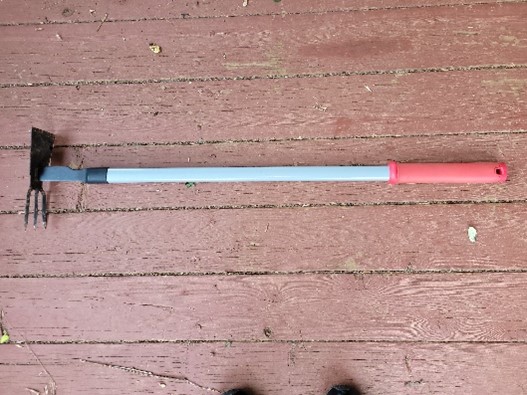
Tool 3 feet long designed for work in raised beds.

Here is a tool that Phyllis Wilburn suggested as a solution for my knee problems. I was complaining about the difficulty of crawling around the garden after Birdseye Pearlwort. She says this tool is her primary weapon combating Common Bittergrass.

The handle is 3 feet long. This tool is designed particularly for work in raised beds or in tight situations where a long handle would be cumbersome. The hoe blade is narrower than a regular hoe. This allows the user to apply more force to the soil. The cultivator side is a bonus. If you are interested, you can purchase the Corona Extended Reach Hoe and Cultivator on Amazon for 17 dollars.

Stan, The Hoe Man

Got Butterflies?

Got Butterflies?

Finally, an article that should have meaning to almost every reader. Everyone I know loves butterflies. Their flash of color and erratic flight cannot help but put a smile on your face and improve your spirits. Now, if you wish this to happen to your face and demeanor, I have the solution: buy one of the many passion vines that LaVille is propagating for the April Plant Sale.

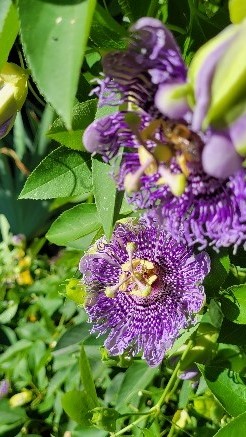
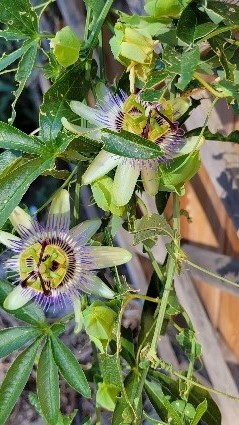
If you buy one at a nursery, you will probably be disappointed. LaVille has found that the Fritillary butterfly is very selective about the kind of passion vine upon which they wish to lay their eggs. They do not like the red or pink bloom varieties. They really love Passiflora edulis and P. caerulea. LaVille is growing both.  So, get one or two vines from her.

You are going to plant them now where they will get good sun exposure. Winter will stunt their growth and you will cut them back to two feet or less. Spring will produce lush growth and Fritillary butterflies will find them and lay their eggs. Then the eggs will hatch, and you will find caterpillars munching away on the leaves. I have to caution you that the butterflies really prefer the delicate leaves of the caerulea. We have to constantly transfer caterpillars from the caerulea to the edulis, otherwise all that will remain is bare stems.

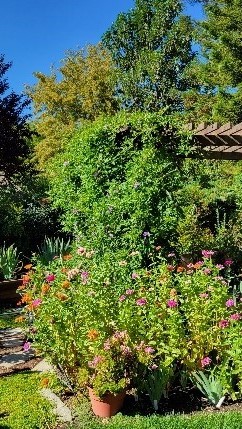
Next, to keep things rolling, you need to provide food for the butterflies. You probably have your favorite butterfly attracting plants. LaVille prefers zinnias as you can see in photo. Plant zinnia seeds in April to greet the butterflies as they emerge from their cocoons.

There you have it—a simple way to make your garden a source of wonderment and joy.

Stan, The Butterfly Man

Watering Wand Problems

Watering Wand Problems

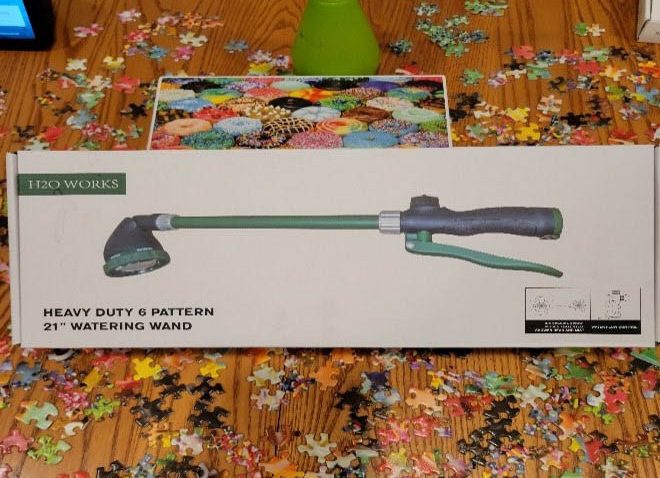
A watering wand still in the box.

Many months ago, I recommended the H2O WORKS water wand—the one pictured below. And it is a great wand . . . until the spray head gets clogged.

In my first article, I lauded the tremendous number of holes in the spray head—hundreds! These create a fine spray that won’t disturb the soil in a potted plant. But these tiny holes tend to get clogged.

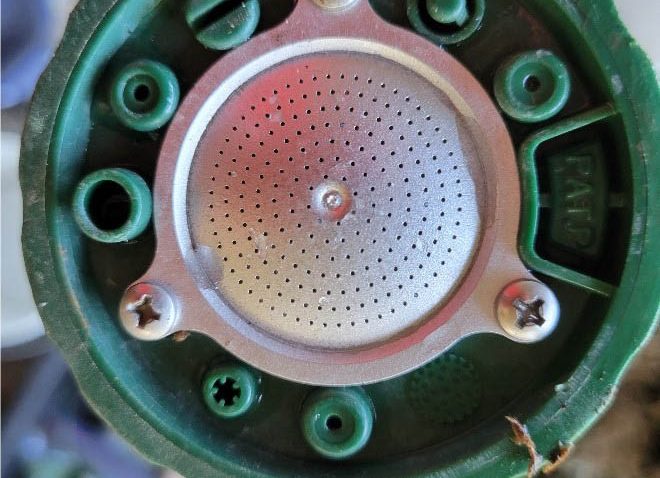
Close up of a watering nozzle.

Now, there is a very simple fix—use your Phillips screwdriver (Don’t tell me you don’t have one of these!} and remove the 3 screws holding the spray head cover (again, shown below). Use a toothbrush (You better have one of these!) and clean the gunk or grit from the screen. Now, if this spray head simply had larger holes, there wouldn’t be a problem, but at least you are able to remove the clogs, which often isn’t the case with hose sprayers. So, if you have followed my advice and have purchased this sprayer, now you know how to keep it working properly—I would be depressed if I learned that you felt I had led you astray.

Stan, The Fixit Man

Scraper Tool

Scraper Tool

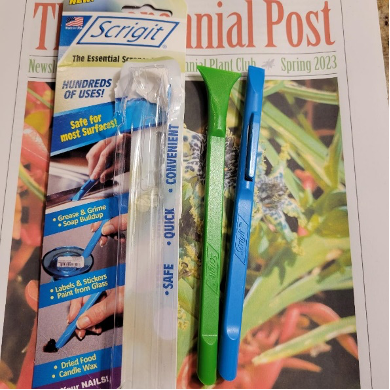
A shot of two scraper tools by the company Scrigit.

I just love it when club members go to the trouble of showing me a new garden tool. This one came from Lorraine. The photo is a little misleading in that it shows both a blue and a green plastic scraper. When you buy the Scrigit brand, you either get blue narrow blades or wide green blades. Lorraine ordered both packages and gave one of each. Now, although this primarily a household tool for scaping surfaces like glassware, windows, counter tops, stove tops sinks, bathtubs, and the like without damaging the surface (so the package says), Lorraine had it in mind for scraping labels off of plastic pots.

So, if you are a dedicated label scraper, you may wish to save your fingernails and make this purchase. If you check Amazon, you will find a variety of options including a set of three different scrapers for less than $5.

Stan, The Scraper Man

Burning Desires Gone Bad

Burning Desires Gone Bad

If you have followed my blogs, you will remember how I have touted the benefits of controlling weeds by burning them. The main advantage is that the weed seeds are destroyed along with the weed.
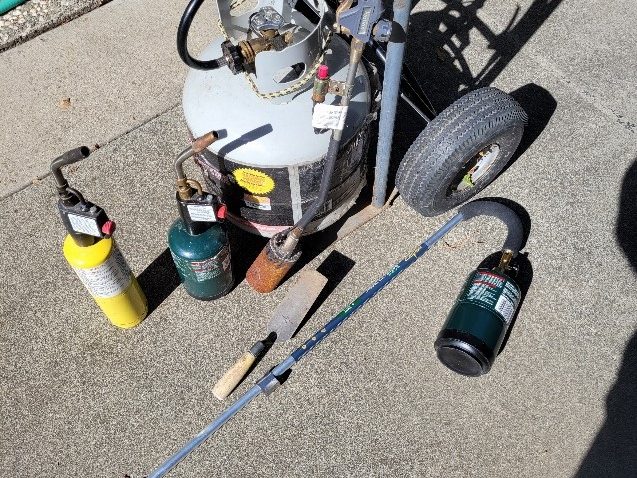
A collection of propane-fueled weed burners.

My experience with weed burning has evolved over the years. The first tool I used was the small green propane tank and torch you see on the pavement in the photo below. I would walk through our garden, bend over, and press the red button to produce a flame that cooked whatever weed I found. I would use a trowel to shield drip lines or valued plants.

When I joined Daisy Mah’s crew at the WPA Rock garden, I used this torch to fry the weeds growing in the paths. This slow process led me to advance to a much bigger torch. I attached a 5 gallon propane tank to a hand truck and wheeled throughout all the Rock Garden paths. It wasn’t long before all paths were weed free.

Recently, due to back problems, I was unable to bend over to reach the weeds. So, I bought a burner with a long tube extension that allowed me to burn weeds while standing erect. This system works well except there is no button to turn the flame on and off as you move around, and the flame is much larger than that produced by the smaller torch.

Well, a month ago, I was using this long burning torch in the garden, and I quickly burned some weeds next to the fence, and then continued to work my way around the yard. I was alerted by my wife, who had been indoors, that there was an emergency. And, sure enough, flames were roaring several feet above our fence. A nearby hose finally quelled the flames, but the damage was done.

What you see in the photo is the view from my neighbor’s yard. My new torch had ignited dry material on the other side of the fence and flames quickly engulfed the redwood boards. It did not help that daytime temps were around 100 degrees. Also, had there not been an open space at the base of the fence, there would not have been any fire damage.
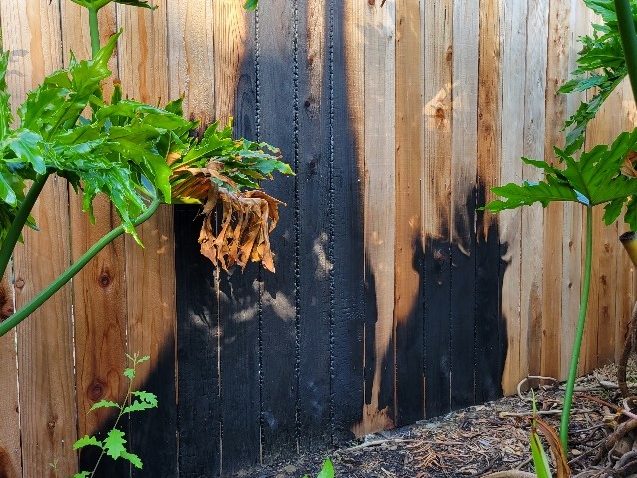
A wood fence with large burnt sections.

When I have talked about the use of a torch to control weeds, I mention the possibility of burning a fence as sort of a joke. As it turned out, the joke was on me.

Happy (but safe) burning,

Stan, The Burning Man

Miracle Worker

Miracle Worker

You must have noticed that the cooler weather and recent rain has really slowed down gardening chores—that is other than trying to keep up with the constant deluge of fallen leaves. With extra time available, LaVille and I have resumed going to estate sales. Last Friday we went to a sale where I was able to purchase 5 pruners and 2 cans of spray paint for $2.

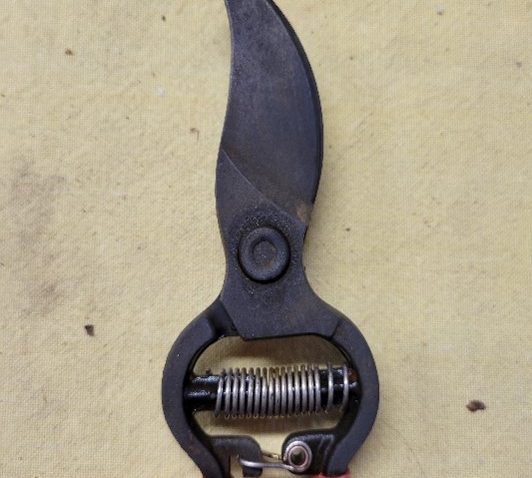
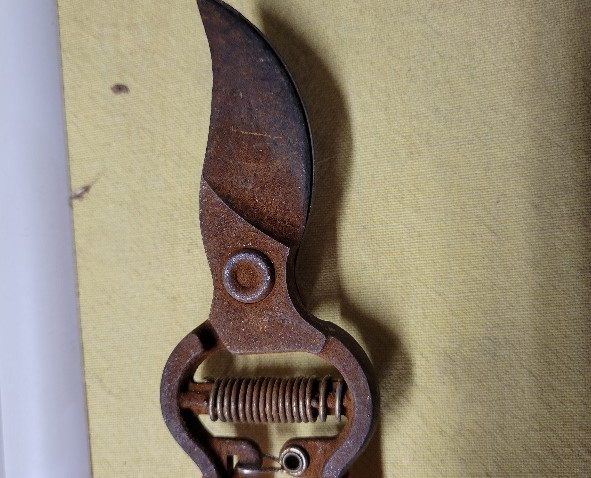
One of the pruners was really encrusted with rust as you can see below. I couldn’t wait to work the magic of a vinegar bath. I know this is old news for those of you who read the “Fun For 3 Dollars” blog from earlier this year, but I just couldn’t resist a repeat performance.

I used the old vinegar that is now stained a dark reddish brown and submerged the pruner for a day. You can see how the rust is now gone and has been replaced by a thin black coating. This is some kind of oxide that I have not been able to identify, but it serves as a barrier against future rust formation. Even if this layer is easy to remove with fine steel wool, it is best to leave it alone.  

Metal pruning shears.

Stan, The Miracle Man


A Safer Spray

A Safer Spray

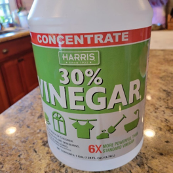
A close-up of the label of 30% concentrate vinegar.Here is an herbicide that is safe to use in your garden—vinegar. Now, table vinegar wont work. It has a concentration of 4-5%. You need to buy 30% vinegar which you will find at Home Depot or Lowes. The thing is, you can reduce the percentage to 20% and it will still be very effective. Dilute the 30% by adding 1 part water to 2 parts vinegar and you will get 20%. I have been testing vinegar spray at the Rock Garden and have found it to be deadly on everything but Bermuda grass. You will find that one application will kill weeds in a very short period of time.


Stan, The Spraying Man

Dig Plant Water Repeat

I just discovered a YouTube web site that you might enjoy. It’s called Dig Plant Water Repeat. It just so happens that the wife of my wife’s current physical therapist makes videos about plants. She is also a PT and loves making videos. People who do videos get paid when you watch the short ads in the programs. She makes 5 new videos each week, so there are hundreds of programs from which to choose. Here are a few of the topics that she has covered: house plants, weed control, propagation, pollinator friendly gardens, drip irrigation, gardening on a budget, cut flower gardens, and garden tools. She lives nearby in Davis, so her planting is appropriate for the Sacramento Valley. Why don’t you give her well designed programs a try? It’s a good way to spend your time when it’s 100 degrees outside. Stan, The Blog Man P.S. I’m considering starting up my own video series called “Work in the Garden  Rest  Repeat” What do you think?

E D Syndrome

For those of you who are not familiar with E D, Easily Distracted Syndrome is a very common ailment which seems to become more prevalent in humans as they age—at least that has been my experience. Perhaps you have fallen prey to this same malady. As gardeners, here are some of the symptoms that you may have noticed:

 You mean to leave water running in a particular area of your yard for 5 minutes, but discover hours later that it is still running. That happened to me last week when I let water run on a wisteria, and didn’t turn it off until 4 hours later when I returned from a medical appointment. Then, I have a dear friend who got distracted and flooded not only part of her back yard as well as her neighbor’s by letting a hose run all night.

You have accumulated a collection of well rusted tools. It was not your intention to leave tools out in the weather, but it has happened over and over again. I won’t name names, but after sharpening hundreds of your garden tools, I can definitely tell that some of you have a serious problem with E D.

You go in the garden with a particular task in mind. Hours later you realize that chore was never even started. Nothing will distract me faster that the sight of a weed that is producing seeds. And perhaps that distraction is justifiable because as you perhaps learned from Patricia Carpenter, weed seeds can stay viable an average of 7 years, with some lasting as long as 20. We planted a morning glory 48 years ago and them removed it several years later. Believe it or not, a new morning glory will still occasionally appear in that area.

You find yourself walking somewhere and then stopping . . . not remembering why you are even there. It truly amazes me that my body has stayed on task, but my mind was completely distracted. I will be standing exactly where I wanted to be—and not have any idea why I’m there.

Now, I don’t mean to alarm you if you have similar experiences. I generally find E D amusing—but not the wasted water episodes. My editor has told me that I shouldn’t describe a problem without providing a solution. The only thing I have to offer is—use your phone. I know the 2 of you are inseparable, so constantly set alarms to get you back on task. Of course, if you can’t find your phone . . . Perhaps you should be thankful that you are still able to move around—even if can’t remember why.

Stan, The E D Man

Hose Helper 2

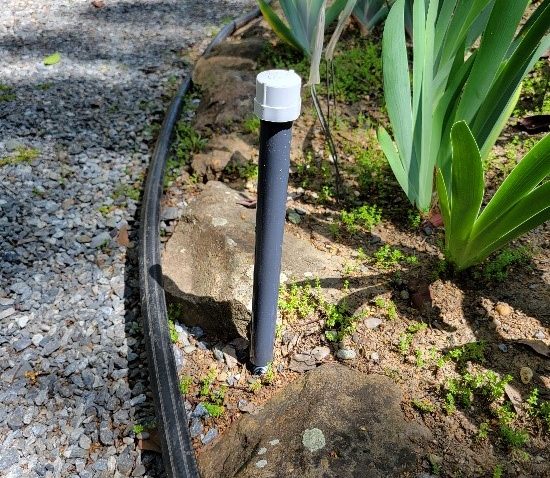
Susan W. read my blog about a hose helper, and then came up with an improvement. Her soil is so rocky that it would be impossible to pound pvc pipe into the ground. Instead, she hammered a short length of 3/8 inch rebar into her terrible soil. At Home Depot she found 1 foot lengths of gray, threaded pvc and screw caps.  When that pvc was slid over the rebar, the cap prevented it from hitting the ground. Now, when a hose is dragged around the hose helper, the pvc pivots and easily lets the hose pass around it. So, you now have a second method of constructing a hose helper. If you don’t want to get involved with rebar, simply use 2 sizes of pvc and place a cap over the upper end of the larger piece. By the way, if you have never been to Susan’s property, make every effort to do so. She and Bill have landscaped their hillside property beautifully—and the view—truly amazing! Yards and yards of planting mix were wheelbarrowed down to each of the beds. Stan, The Envious Man
Hose Helper Rebar + PVC

Threaded PVC and cap over rebar