by Stan Logan | Mar 19, 2020 | Garden tools, Irrigation
What can you say about hoses? That’s what I asked myself when it was suggested I do an article about hoses. I’ve been pondering this question for several months now. I have some thoughts that are possibly worth sharing . . . or not.
The most basic rule as with practically all things you buy: “You get what you pay for.” If you buy a cheap hose, you will likely have problems with kinking, the fittings will eventually leak, and the hose material will not bear up against the ravaging of the sun’s rays. Other than this obvious cost consideration, there are other decisions to make.
Most garden hoses have a 5/8 inch inside diameter. ½ inch hoses are lighter, have reduced volume flow, and are generally of low quality. How much length do you need? Most hoses are 50 feet long. I’ve noticed a long monster for sale at Costco.
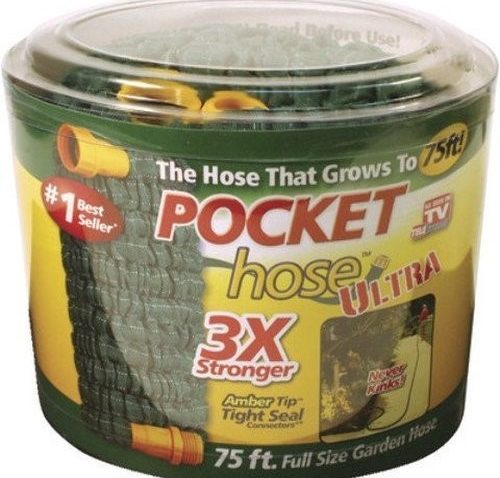
Pocket hose
You must have noticed the “Pocket Hose” or the other numerous expandable hose brands that seems to be the latest hot item on the hose market. You can find it for sale in a container about the size of a lunch box. You have to use one of these to appreciate them. It weighs almost nothing, so if aging muscles have difficulty dragging a heavy hose around, this may be the hose for you. You don’t have to worry about knocking things down as you drag the hose because it doesn’t ever lie in stiff loops on the ground. When you release the pressure, the hose shrivels up to almost nothing and can be stored in a large flower pot. However, these hoses are notorious for developing leaks in a very short time. They have come out with supposedly improved models. I have to admit that I bought one of these Pocket Hoses at Target because it was on clearance for $14—I can’t resist a sale. The regular price is over $30. You see, I had found a Pocket Hose at a garage sale months ago, and LaVille really loves it. It developed a leak next to a fitting, but I was able to fix it. I think it will be only a matter of time before her hose is a goner, but now I have a back-up. I figured that $14 for a hose that my wife loves for one year is worth it. If you choose to also gamble, don’t leave the pressure on after use. Also, stepping on it can result is premature death . . of the hose, that is.
Then there is the stainless steel hose that has recently appeared. If you believe all the hype, this is the hose of the future . . or not. Since I knew nothing about these hoses, I looked at the comments for the different models you can buy on Amazon. I hope you have used consumer comments to help you select products when you buy online. These comments are often very revealing and often amusing. Among the comments about these hoses were many complaints about the low volume flow and frequent leaks—but these varied a great deal from brand to brand. It once again revealed the fact that you get what you pay for.
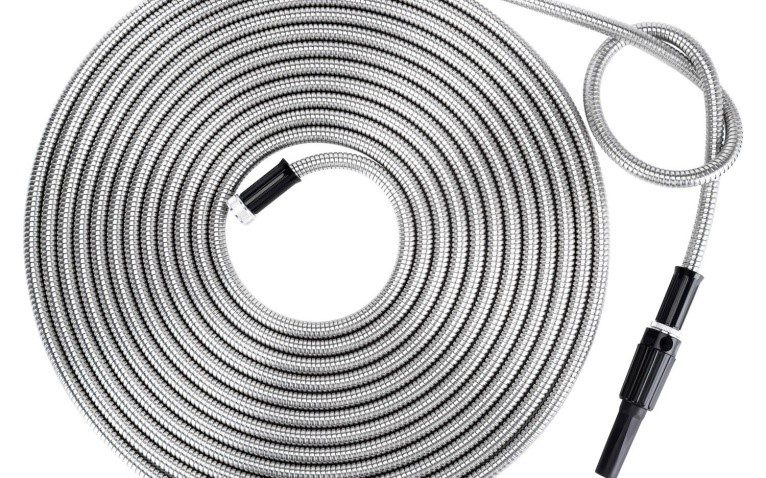
Steel Hose
How about coiled hoses? I hate coiled hoses. If they don’t result in premature death from tripping on them, they will cause a heart attack for all the stress they create when they get tangled or hung up on something. Volume flow is low. These stupid hoses do not last very long either. That being said, we have one of these . . I don’t know why . . except they do recoil into a relatively small space. Actually, my proof reader says she likes this hose and uses it more than any other hose. And here I was ready to pull out that Pocket Hose that I was saving for a leaky day.
Hope you’re a happy hoser,
Stan, The Tool Man
by Stan Logan | Mar 19, 2020 | Garden tools, Safe Gardening
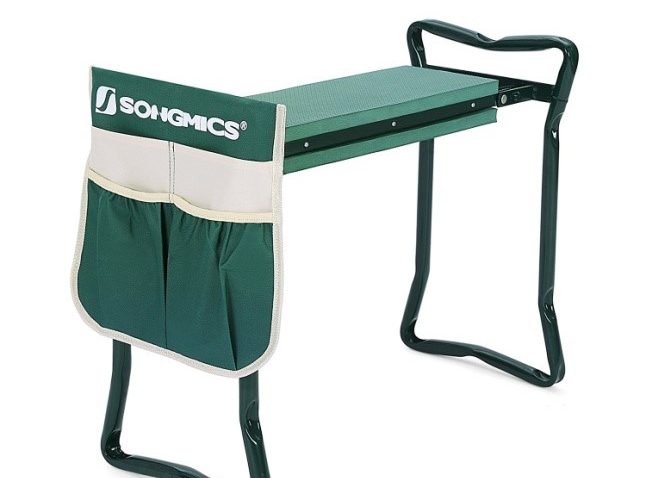
Kneeling Bench
Not all of us are comfortable kneeling, but playing in the garden often requires it. My kneeling days are numbered, even though I’ve been protecting my knees with knee pads for years. In fact, I have a set for indoors and a set for outdoors. I wear knee pads so much that I just keep them on when I nap in the recliner between play sessions.
An alternative to wearing knee pads is using kneeling pads—one inch thick pads of soft material that you place between you and the ground. We must have 3 or 4 around here. I’ll grab one for LaVille when I catch her kneeling on a hard surface. These pads are fine to use, but when you move around a lot, like when I’m chasing weeds around the yard, it’s a nuisance to carry the pad with you.
Here, for you persistent kneelers, is a device that you may wish to purchase and use. It’s a seat bench that can b e turned up-side-down and then used as a kneeling pad. Look at the attached picture to see what I mean. You can work while bending over from the bench, or you can kneel when it’s flipped over. Perhaps the best feature is the fact that you have 2 supports on the sides that will help you get up—which is the hard part. Do you remember that the main reason for using a rigid plastic bucket when weeding was that you could use it to help you get up? An additional feature is that the legs can folded in for storage.
There is a variety of kneeler benches at Amazon for less that $40.
If your knees could talk, they would thank you. The side supports may just be the feature that will save you from taking a face plant into the garden—and nobody likes to grow face plants.
Keep on kneeling,
Stan, The Tool Man
by Stan Logan | Mar 19, 2020 | Garden tools
power washer
I really like to clean. One of my favorite chores is to do the laundry. Polishing silver is great fun. I used to collect antique wooden pulleys. I would clean them up and refinish them to make them look new. Of course, that reduced their value, but I didn’t care. I actually like to weed—it’s just another form of cleaning. I could go on and on, but I think you get the idea.
Today, my favorite cleaning tool is the power washer. I use it so frequently that it is always connected and ready to go in the back yard. Here are some of the things I have cleaned in the past with a power washer: used clay pots, a bird bath, water barrels, large tools I have bought at garage sales, sidewalks and pavers, windows, kids’ riding toys, cars, the barbeque, the organic, garbage, and recycling bins, and shovels and tarps after use. After the rainy season, I’ll go around and clean off all the dirt and debris that rain has splattered up on the house and planter boxes.
I hope you have thought of ways you could use a power washer. I strongly suggest that you get an electric model—not gas. Realize that you will have to be able to plug this device into an electrical outlet and attach a hose. When you move this device around your yard, you will be dragging also three lines: electric cord, hose, and tubing that leads to the spray wand. So some strength and patience is required.
Many different models are available on line and in big box stores. You shouldn’t need a power washer that puts out more than 1800 psi (pounds per square inch). My old one only puts out 1350 psi and it has been sufficient for almost everything.
So if you are a cleaning freak as I am, this is the tool for you.
Happy cleaning!
Stan, The Tool Man
by Stan Logan | Mar 19, 2020 | Garden tools
rake
You say, “What possibly could be said about a rake?” Well, let’s see what I can come up with.
You must realize that there is a tremendous variety of rake designs. Years ago my favorite was the bamboo rake. It was light weight and the tines nicely flexible. Years later I used a plastic rake to gather piles of leaves in the neighborhood streets for the “claw” to pick up. It served its purpose well until I realized that raking the street ground down the tines until they no longer had hooks at the ends. You may have seen the rake contraption that closes on the leaves so they can be picked up. I haven’t tried that one yet because it looks too heavy to use for long periods of time. As of late I have settled for a lightweight metal rake that I actually paid retail for at Davis Ace. It’s one of the few tools that I didn’t get at a garage sale. It seems every time I come across a metal rake at a garage sale, it is in really rugged condition. This is probably because they last so long. The metal rake works well in my yard and also the street. I recently found that large leaves like magnolia leaves can be picked up when they get imbedded among plants by stabbing the tines through the leaves.
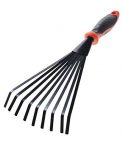
While working at an iris garden recently, I was wishing I had brought along one of my old favorites—a hand rake. Mine is 17 inches long with a tine spread of 5 inches. I used to use it a lot when I was more OCD than I am now. (At one point I was sucking up every last hackberry leaf with a vacuum cleaner—sick.) If you have a situation where leaves get amongst your plants, and you tend toward OCD, consider purchasing a hand rake.
Another unusual use for the hand rake is to assist you in removing aphids from plants when using a hose sprayer. By supporting a branch from behind with the rake, the branch won’t bend away from you and practically all the aphids will be blasted away.
Hand rakes are a common item at nurseries and are quite cheap at Amazon.
You know, it’s OK if you are OCD if it makes you happy.
Stan, The Tool Man
by Stan Logan | Mar 19, 2020 | Garden tools
Soil Scoop
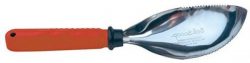
Here is the perfect tool for potting plants. You are probably using a small bucket or can to fill a new pot for transplanting. Try this tool instead. The comfortable grip of the soil scoop gives you good leverage and the concave shape allows you to quickly transfer soil from a bag or bin. You may wish to use this tool to form furrows in your garden and the serrated edges can also perform cutting action when roots are encountered. The metal scoop is stainless steel so your tool will maintain a like new appearance. The soil scoop is produced by Garden Works and can be purchased for less than $16 on Amazon Prime.
Happy scooping,
Stan, The Tool Man
