by Stan Logan | May 27, 2021 | Container plants, Garden tools, Irrigation
With all the pandemic caused emphasis on home improvement, this would have been a good article to write a year ago. Better late than never. As usual, wanting to advise others comes as a result of mistakes I have made, some of which are described below.
Size: Length can be whatever you want. Width, however, should be no more than 4 feet. I have 3 beds that are 5 feet by 8 feet and it is difficult to do any work near the center of the beds. The one 4 footer is so much easier. The walls of my beds are made with three 2 x 6’s, so they are about 18 inches high. Now that I think of it, 24 inches would have been much better in terms of having to bend over less. But then, I think proportions look better at 18”—you gotta look good even if it’s painful. The higher you raise the box, the stronger the support needed to keep boards from bowing out if they are long. People use raised beds to make tending them easier and to create an enclosure for the new improved soil that can be brought in that, hopefully, plants will love. Most people find that a bed 10 or 12 inches high works well for them—not so much for growing tomatoes which are best planted 18 inches down.
Materials: Most people use wood. Redwood is probably the best. When you are picking out your 2-by boards, try to find those that have the most heartwood. The reddish heartwood is far more resistant to rot than the pale sapwood. Cedar is another good choice. Pressure treated wood is more controversial. No arsenic has been used in this wood since 2003-4. Currently 2 different copper compounds are used and although no traces of these chemicals have been found in either soil or vegetables, pressure treated wood is not recommended for planter boxes in which food is grown. You can alleviate you fears by lining the box with heavy plastic—say 6 mil. You can also seal the box with paint or another kind of sealer. One caution—avoid breathing the dust when cutting pressurized wood. Wear a mask. I know you know how to do that. More expensive, but far more durable is construction with masonry. There are all kinds of attractive alternatives here. The drawback is that you have to lean over farther to work with your plants and the material is not gentle on elbows and knees
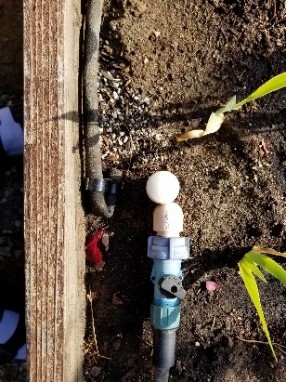
Misc. Plan ahead and bring irrigation lines up into the box. Cover the bottom with hardware cloth—you know, the substantial ¼” wire mesh, to keep varmints out. A layer of weed cloth will also discourage the invasion of roots from a nearby tree. Trust me—tree roots will love the great soil and water you have provided. If you are using wood, consider installing flat boards on the top edges for ease of sitting. Don’t just use screws to hold lumber together. Use lag screws, or better yet, use bolts with washers. If using lag screws, predrill to prevent splitting. You can attach a band of copper mesh around the outside to keep snails and slugs out—but not earwigs. Finally, as you can see below, if you use treated posts, you have to add preservative, sealer, or a cap to cuts that have exposed untreated interior areas.
In-box irrigation |
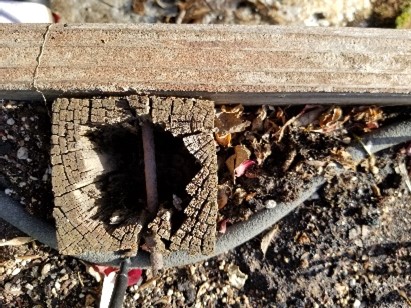 Rotting post |
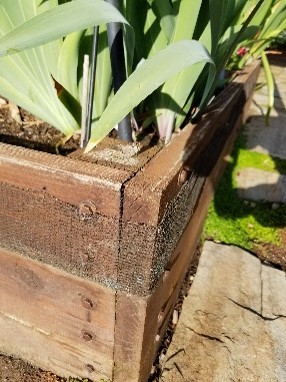 Copper mesh |
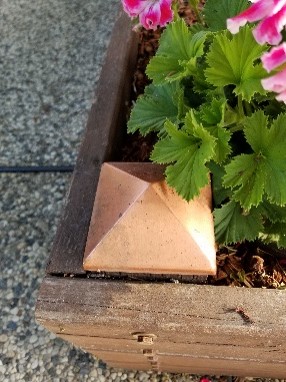 Post cap |
Why does most of my learning have to come at the expense of mistakes I have made?
Stan, The Blog Man
by Stan Logan | May 24, 2021 | Irrigation
I was recently notified about writing a blog concerning a very serious matter. You see, this person (who will remain nameless) accidentally left a hose running all night resulting in the flooding of her back yard. She was rather upset about this and felt that she, as well as others, need some suggestions to prevent this happening again. Here are some ideas:
- Electronic and mechanical timers that attach to hose bibs. The mechanical ones may not work if the volume is low.
- Electronic timers. These small battery operated timers are otherwise used as kitchen timers.
- Alexa is always willing to set an alarm for you.
- Exercise tracking watches sometimes have an alarm feature.
- Battery operated flood detectors will issue an alarm if water reaches the sensor.
- Rubber wrist bands that you store on the hose bib can be worn as a reminder.
- The most easily used device is your phone which I know is tethered to your body.
Hopefully you will find one or more of these suggestions useful so you won’t make the same mistake that Beverly (oops) made. Coincidentally I am using a wrist band right now.
Stan, The Blog Man
by Stan Logan | May 21, 2021 | Garden tools, Irrigation
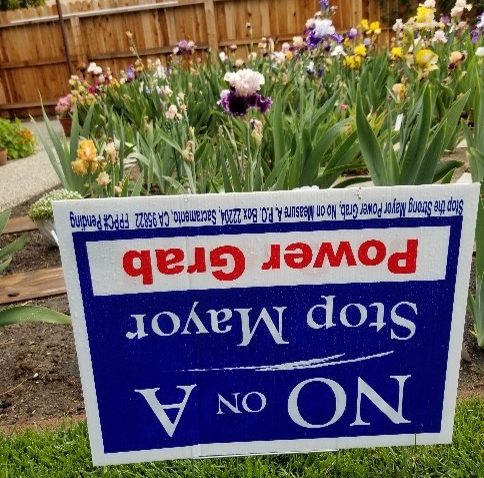
I recently had a newly cultivated area that I wanted to let dry out until planting. I used 2 political signs to ward off the spray from 2 sprinklers and they really worked well. By cutting off all but 6 inches from the supporting wire of the sign, you can poke it into the ground and move the shield wherever you want. The sign is made of corrugated plastic so it is impervious to water. On the other hand, you might want to shield certain plants from harsh sun rays. When not in use, these flat shields store efficiently.
As you know these signs are readily available when political issue are made public. You can either wait until issues are settled, or simply pick up the signs when they don’t agree with your viewpoint. ( My editor says I can’t say that.)
Stan, The Blog Man
Repurposed political signs as garden shields
by Stan Logan | May 17, 2021 | Safe Gardening
Here, unfortunately, is an example of “Do as I say, and not as I have done”. Moderation is a goal to which most of us aspire—whether it is diet, sun exposure, exercise routines, or mountain climbing. Gardening should especially fall into this category. For instance, I was barking in the front yard today. (“Barking” is the technical term for applying bark to your landscape.) It was 90 degrees out. It wasn’t too long before I was tired. So rather than pushing it, I went into the house and relaxed on my recliner. And, of course, fell asleep. I was proud of myself because I quit before I became exhausted, which has been the usual outcome of my gardening activities. (For your information the way you determine whether you are just tired, or truly exhausted is by the length of your tongue hanging out of your mouth.) This pause was just the first of many that occurred through the day. The motivation to overdo activities is to finish the job, and it is a very difficult goal to resist. But I implore you to consider your physical well being over your mental wellbeing (be it as it may). Give your body a break and take a break. The weeds will be willing to wait until you return. Besides, they will be easier to find. The mess of leaves will remain—perhaps not in the same location—but they will be somewhere. Water those potted plants and put them into the ground tomorrow. I think you get the idea. Be sensible in your gardening activities—save some of the fun until tomorrow . . or next week.
Stan, The Rested Man
by Stan Logan | Apr 28, 2021 | Soil
Have you ever paused for a moment when removing the debris from around a plant? That collection of organic matter that covered the ground not only helped to retain soil moisture, but eventually would decompose and release nutrients back into the soil. So as long as the debris didn’t harbor disease, the plant would be happier if you left things be. But would you be happier? Probably not, unless you dress up the surroundings with mulch. Even then I have seen examples of mulch covered gardens that I consider downright ugly. 3 to 4 inches of ugly doesn’t do a thing for me. On the other hand, I love the effect created by a covering of mini bark. I used to be able to buy “Pathway Bark” from Garden Time at Lowes, but now all they have available is “Pathway Groundcover” which more closely resembles sawdust than bark. If you were at Jeannie’s pop-up sale, you might have noticed how great the landscaping appeared as it was dolled up with a covering of mini bark. I asked her husband and he said he was able to get at Hasties. He said it was rather expensive though.
As usual, I have strayed from my original topic—that of the dilemma of whether or not you should clean up around plants in your garden—are you making the plants happier, or making you happier? You can do both, but more often I simply opt for me. Just being selfish, I guess.
Stan, The Blog Man
