by Stan Logan | Jun 7, 2021 | Garden tools
There was once an old man that lived down the street. Along with other home owners in the neighborhood, he had a magnolia tree growing in the middle of his front lawn. Every day I would see him wandering all over the lawn picking up magnolia leaves with a grabber. I assumed he probably was too stiff to bend over, or perhaps was fearful of doing a face plant on display for the entire neighborhood. He eventually had the tree cut down so the only time I would see him is when he would drive by. Dr. Chambers died probably 30 years ago.
I recently spruced up my front landscape with a yard and a half of mini bark from Hasties. I appreciate the improvement so much that I constantly am out there with a grabber picking up the magnolia leaves that my nextdoor neighbor’s tree provides. I wonder what the neighbors think of me?
Stan, The Old Man
by Stan Logan | Jun 6, 2021 | Trees
This is a science lesson. So if you have no interest in science, stop reading now.
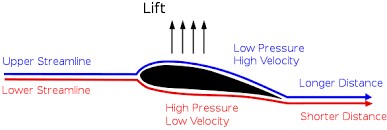
You know the saying, “You cannot keep an old dog from teaching old tricks.” I taught science for 37 years, so I cannot help thinking about scientific principles while gardening. For instance, every time I use my leaf blower to move a stubborn magnolia leaf that my neighbor’s tree has provided, I think about Bernoulli’s Principle. Good old Bernoulli discovered that the faster a fluid moves, the lower the internal pressure. The next time you fly (in an airplane) look at the wing. You will see that the upper surface is curved compare to the bottom surface. This causes the air moving over the top of the wing to travel a longer distance than air beneath it. The air on top therefore has to move faster to get the back of the wing at the same time as the air beneath it. Since the pressure on top is reduced, the greater pressure beneath will lift the wing (and hopefully you along with it).
Bernoulli’s Principle
So why, when I blow air over the top of a magnolia leaf, doesn’t it rise? Well, unfortunately I know the answer. Technically it is called “angle of attack”. (LaVille and I used to fly small planes.) The air blown at the leaf is coming down on it rather than parallel to it. I supposed if I laid the blower down on the ground so that the air flowed along it, the leaf might rise. But that would look stupid, and I get ridiculed enough as it is.
So the next time you are out blowing leaves and a leaf sticks to the ground so you have to go and kick it, yell out “Where’s Bernoulli?” . . Or the next time you are flying along in a plane, say a silent (or loud) thanks to Bernouli. He’s doing a great job of keeping you up.
Stan, The Science Man
by Stan Logan | Jun 5, 2021 | Garden tools
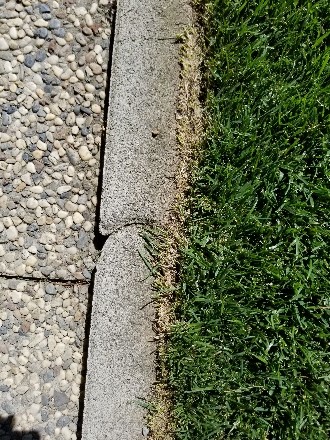
If you look at the first photo below, you can see that absolute mess I made trying to edge my otherwise beautiful lawn with a string edger. Lawn edging is something that I have never been able to do well. Well, I solved my problem. I removed the guard from the edger. Now I can actually see what I am doing, and have been able to do a good job, if I do say so myself. If you also choose to remove the trimmer guard, you must wear eye protection. I would also suggest that you floss your teeth when your edging is finished.
Stan, The Much Improved Man
Butchered lawn edging |
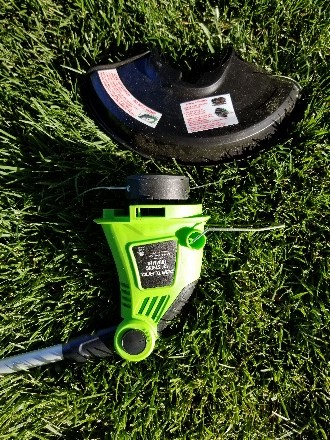 Trimmer with guard removed |
by Stan Logan | Jun 4, 2021 | Garden tools
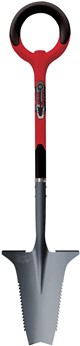
Root Slayer |
Here is another tool recommended by Anita Clevenger. The Root Slayer is a shovel with a sharp V-shaped tip and blade edges with saw teeth. It is perhaps Anita’s favorite tool because using it vastly reduces the strain on her hands and wrists. She says it’s absolutely essential for digging around trees. One of the drawbacks to this shovel is that it will slice right through irrigation lines as well as roots. Then too, the tool description says not to use it for prying action. The Root Slayer comes in 3 basic models—a straight long handle version for $47, a short heavy-duty version for $64 and a light-weight short version for $35. In Amazon’s description the light-weight shovel is suggested “for women and mature gardeners”. If you are not sure if you fit into these categories, give me a call and I’ll help you decide.
Stan, The Tool Man
P.S. A further discussion with Anita revealed that there are many models of the Root Slayer. Her model is actually the lighter version discussed above, but with a different handle than the ring handle. She feels the lighter shovel is better because it can maneuver into smaller spaces. She also indicated that this is a popular shovel with backpackers and users of metal detectors. I suspect that short 29” “Mini-Digger” or the trowel would be useful here. |
by Stan Logan | May 31, 2021 | Garden tools
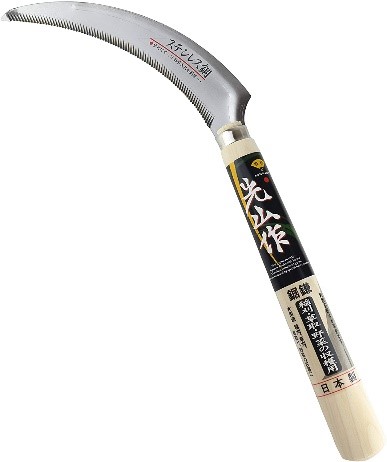
Here is a tool via Anita Clevenger. The Japanese grass sickle saw is an inexpensive tool that will really save you a great deal of time when it’s time to cut back your ornamental grasses. There are many models, but the one Anita bought at Home Depot is unique in that the inner blade is a fine-toothed edge that is extremely sharp—I mean really, really sharp. Wear a substantial glove with the hand you use to grab a bunch of grass and slice off that bunch with a careful quick pull. The one model I found on Amazon with a finely serated edge is the “Hounenkihan Japanese Grass Sickle Saw” and runs $16.99. Remember to count your fingers when you finish the job. You may have left something behind.
Stan, The Tool Man
Japanese grass sickle
