by Stan Logan | Nov 10, 2021 | Garden tools
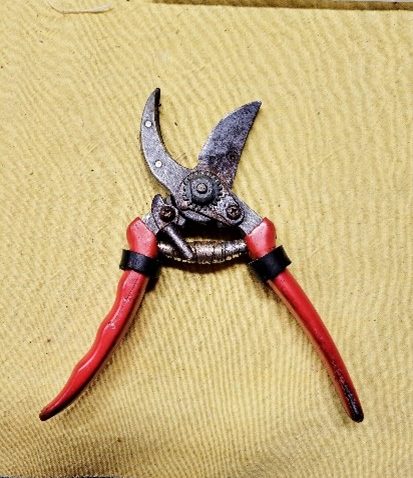
Before Plasti Dip Clippers |
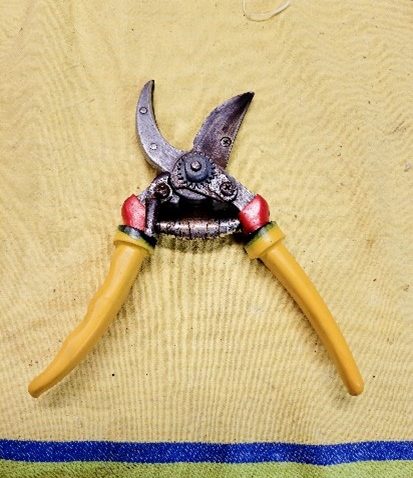 Clipper handles after Plasti Dip |
LaVille kept complaining about her favorite pruner. Her hand kept slipping down the handles toward the blades where she has less mechanical advantage. My first solution was to slide a couple pieces of rubber hose over the handles to act as slippage stoppers. Well, that worked fairly well except she started developing a callus where her hand met the black hose piece. My latest attempt to alleviate her agony was to buy a can of Plasti Dip. This is available on Amazon in a good variety of colors. I chose yellow as it is my go-to color for finding misplaced tools. You dip the tool handle into the tall, slender can and hang the tool to allow it to drip off excess and dry for 4 hours. What you see in the second photo is the result of 3 dippings.
You know, if you accomplish nothing else, you could use this technique to identify your own tools. Don’t you think it would be classy for all your tools to have the same color handles?
Quiz of the month. You will note that I ended up with a tool with red, black, and yellow handles. Name 3 major countries that have these 3 colors in their national flags. The first reader to respond by email with the correct answers gets . . . . nothing but my admiration. I know—Wow!
Stan, The Helpful Husband
P.S. You may have noticed in the first photo that the grips had worn through to the metal. You may consider this technique as a nifty means of tool upkeep. If nothing else, I would suggest you try Plasti Dip as simply a very different and easy project.
by Stan Logan | Oct 25, 2021 | Garden art
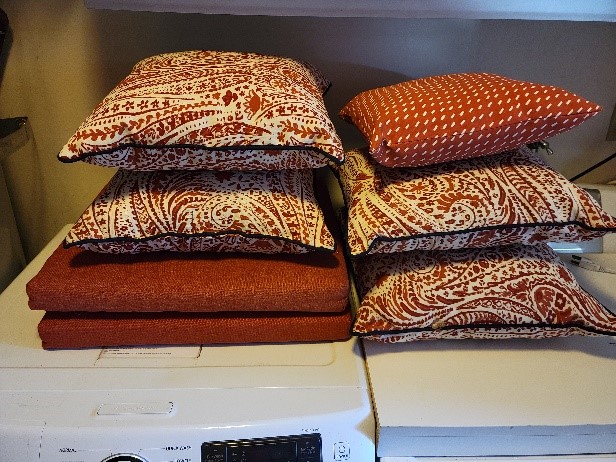
Outdoor pillows
The timing is right for me to pass on a cleaning shore I just discovered. The cushions you see below were on a bench in the back yard. When I pulled the bench under cover before the recent storm, I found the cushions to be covered with a sticky substance. The bench is located under our huge hackberry tree, and although I applied a systemic, the wooly aphids attacked again. Power washing did a decent job of cleaning the cushions but left them soaked. Hanging them on a clothesline left them soppy at the bottom. Then I thought of the clothes washer thinking that the spin cycle would remove most of the water. Since the cushions were small, I was able to fit several at a time into the washer. I used very little detergent and the cushions came out sparkling and practically dry. A fan finished the chore.
So, if you have outdoor cushions, now may be a good time to wash them before storing them away for the winter particularly if they got wet in the recent storm. If your cushions are large, I would still suggest you try squishing them into your washer. But better consider the cushion content first. I wouldn’t use this technique of washing unless the stuffing is a foam rubber pad. A front loader machine might also work better than a top loader since there is no agitator to mangle the cushions.
Stan, The Washer Man
by Stan Logan | Oct 22, 2021 | Design
If you are reading this article, you are probably of an age when you realize that life is short. To that end (so to speak) we gardeners must do all we can to surround our remaining lives with glorious plants. So when you decide that a plant in your garden no longer falls into the “glorious” category, grab your trusty spade and give that plant a good shovel pruning. Then, replace it with a new plant that will lift your spirits to a new level. However, limit your shovel pruning to your own yard. Your neighbors may not appreciate your efforts to improve their lives.
Stan, The Shovel Pruning Man
by Stan Logan | Aug 28, 2021 | Garden tools
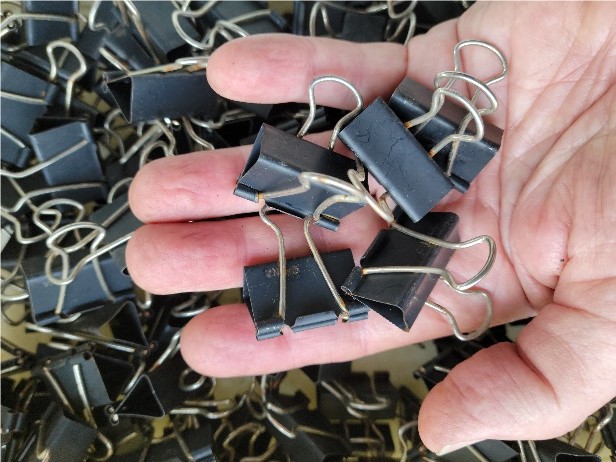
Well, if you don’t have a supply of clips, I certainly do! I have come into possession (trying to be vague here) of probably 100 stationery clips. I thought they would be useful for attaching photo labels at the upcoming Fall sale. Since Rise has been able to find some classy card holders for us to use, I have plenty of clips to share with everyone who can use them. You can see by the photo below how the clips could be used to seal a bag of garden fertilizer (remember my recent blog about fertilizer lumps?). They could also be used to attach plants to a structure—the clip would not have to pinch the plant. I am currently using clips to attach shade cloth to wire lines. Heck, you could use a clip to secure outgoing mail to your mailbox. Although these clips have a touch of rust on them, they have all been through the dishwasher, so they are clean enough to use in the kitchen to seal food bags. Right now, next to me, is a cupboard where I keep a huge bag of oatmeal that I get from Costco—sealed with a clip.
So, what I would like you to do in the next few days, is consider how you could use these clips. Then, when you grab and handful, let me know what you have come up with, and I can add an addendum to this blog. Help me out here—my editor says clips are boring.
Stan, The Blog Man
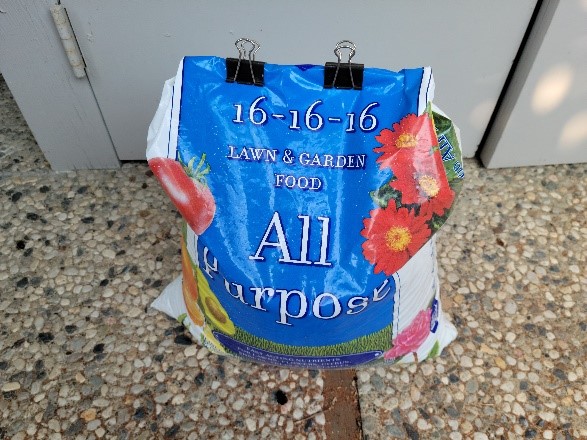
Stationery Clips repurposed to keep fertilizer from clumping
How many ways can you use stationery clips in your garden?
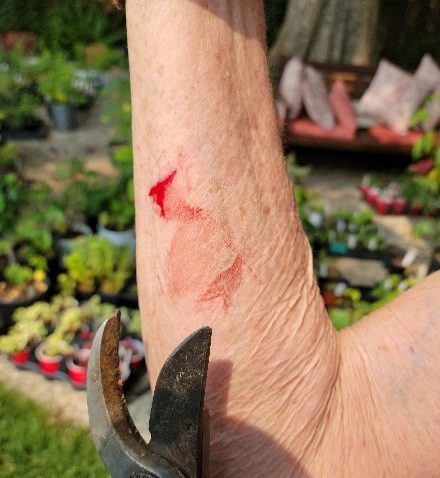
by Stan Logan | Aug 28, 2021 | Garden tools, Safe Gardening
Armed Conflict
As the person who sharpened the tool shown, I feel it is my duty to warn you of a particular situation that may result in a wound like the one in the photo. It is important to remember that when yanking on plant material, that when that material comes loose, the grasping arm may suddenly fly backwards. If your other hand is holding a sharp object, that object may come into contact with said arm, resulting in skin penetration and a leaking of bodily fluids. To that end, please use extra caution when using one of the tools I have so thoroughly honed. It would ease my mind if you would create a first aide station in your back yard that would include a lot of bandages and perhaps a tourniquet.
Stan, The Concerned Man
